This region consists of seven bird communities, South-western Forest, South-western Woodland, Mediterranean Mallee-heath, Open Mallee, Shrubby Mallee, Inland Woodland with Eucalypt, and Mulga. Mediterranean Mallee-heath, Open Mallee, and Shrubby Mallee all occurred frequently in the mallee woodland and shrublands and Eucalypt woodland Major Vegetation Groups (MVGs). The South-western Forest and South-western Woodland bird communities occurred most in forest and woodland MVGs respectively. Five of the seven communities in this region are distributed across both eastern and western Australia, indicating that the conformity of these bird communities over broad scales outweighs the effect of species restricted to either the east or west.
Eucalyptus woodland associations predominate the bird communities in this region, with mallee vegetation communities prominent across the east and west. However, not all bird communities are associated with Eucalypt woodlands; the widespread Mulga bird community is more closely associated with Acacia dominant (predominantly Acacia aneura) shrublands and woodlands, and the South-western Forest bird community is closely associated with Eucalypt open forests and Eucalypt tall open forests. The banksia woodlands of the Swan Coastal Plain and Kwongan proteaceous heathlands of the south-west biodiversity hotspot are typified by a distinct nectarivore-rich bird assemblage but are not represented among the current typology.
The bird communities Inland Woodland with Eucalypt and Mulga were very similar in terms of species composition, with the main differences related to a subset of Eucalypt-associated bird species that were rare in the Mulga bird community (Australian Ringneck, Grey Fantail, Striated Pardalote and Weebill). Fire is less a driver of bird species composition in mulga woodlands as compared with dynamic rainfall patterns, but where fire does occur, it does impact the structural characteristics of Mulga woodlands, which then influences changes in bird communities (Leavesley et al. 2010).
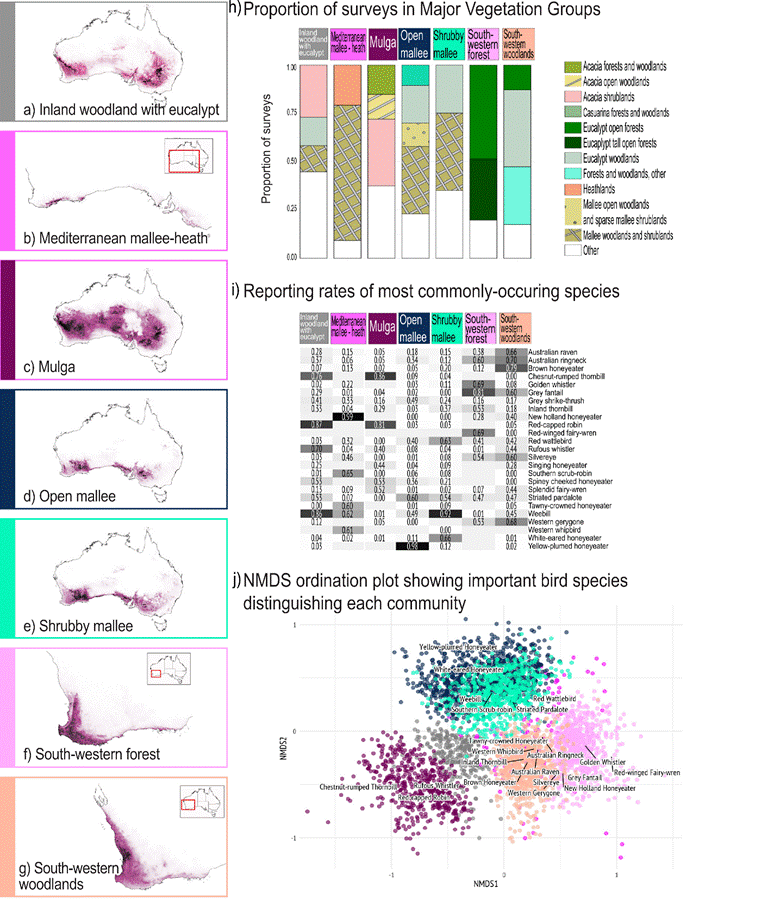
Figure S1.7 a) to g): Inset maps show location of region, larger maps show modelled distribution of communities based on Maxent models, with darker shading representing a higher likelihood of occurrence. h) proportion of surveys in each community occurring in Major Vegetation Groups (MVGs; MVGs in which >10% of surveys were located shown). i) reporting rates (RR) of the top 5 most commonly occurring species in each community. j) Non-metric multidimensional scaling (NMDS) ordination plot depicting the location in multidimensional space of key species that distinguish communities in this region.
South-western Forest
Geographical occurrence
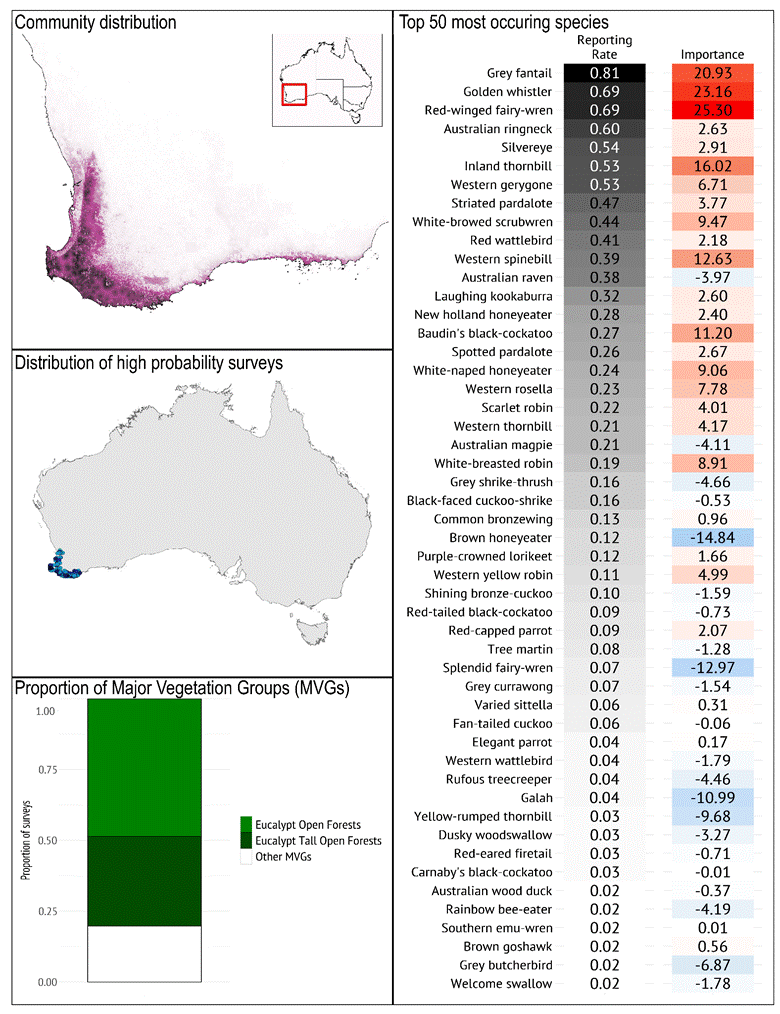
The South-western Forest bird community occurs in the south-west corner of Western Australia, from Bindoon (north of Perth, WA), running around the western corner of WA with the main occurrence of the community ending at Cape Riche, and pockets of occurrence as far east as around Walpole-Albany and inland at the Porongorups. The community is most likely to be found in wetter areas within the range.
Species composition
Typical species: The South-western Forest bird community is typified by the prevalence of Grey Fantail, (Western) Golden Whistler, Red-winged Fairy-wren, Australian Ringneck, and Silvereye. It is best distinguished from other bird communities in the South-western Australia region by the prevalence of Western Gerygone, Golden Whistler, Baudin’s Black-Cockatoo, and Red-winged Fairy-wren, and the low prevalence of Rufous Whistler.
As the most mesic bird community in the cluster, South-western Forests had the highest rates of occurrence for the Grey Fantail and Golden Whistler; two species more commonly encountered in mesic regions than in the arid-zone. In addition, this is the only bird community in which Red-winged Fairy-wren (a mesic-habitat associated bird) is present. Notably, the Red-winged Fairy-wren is absent from the South-western Woodlands bird community, which also overlapped with this species’ distribution.
Guild structure: The South-western Forest bird community is dominated by small- and medium-bodied insectivores that forage in a range of strata from the ground to the canopy (e.g. Grey Fantail, Red-winged Fairy-wren, Golden Whistler), and many parrots and cockatoos (e.g. Australian Ringneck, Baudin’s Black-Cockatoo, Western Rosella, Purple-crowned Lorikeet) with relatively fewer honeyeater species than other communities.
Temporal dynamics: The mass flowering of marri, jarrah and karri are associated with a large influx of nectarivores especially Purple-crowned Lorikeets, Western Spinebill, Brown Honeyeater, New Holland Honeyeater and the Western Australian White-naped Honeyeater (now considered its own species: Gilbert’s Honeyeater).
Geographical variation: The limited distribution of this community means that its common species all occur throughout its extent.
Vegetation/habitat associations
The South-western Forest bird community occurs primarily in Eucalypt open forests, and Eucalypt tall open forests Major Vegetation Groups (MVGs). The dominant tree species in these forests include Karri Eucalyptus diversicolor, Jarrah E. marginata and Marri Corymbia calophylla. The understorey is often dense with intermittent occurrences of heathlands and granite-outcrop associated vegetation. The forests in the south-west are typically taller, with a denser understory, than those in the north and east. Karri forests occur only in the south-west of this area, while Jarrah and Marri forests are more widespread. Across the region, the forests have been heavily impacted by logging activities, as well as clearing for agriculture and mining in some areas, particularly in the north (Vasuki et al. 2019).
South-western Woodland
Geographical occurrence
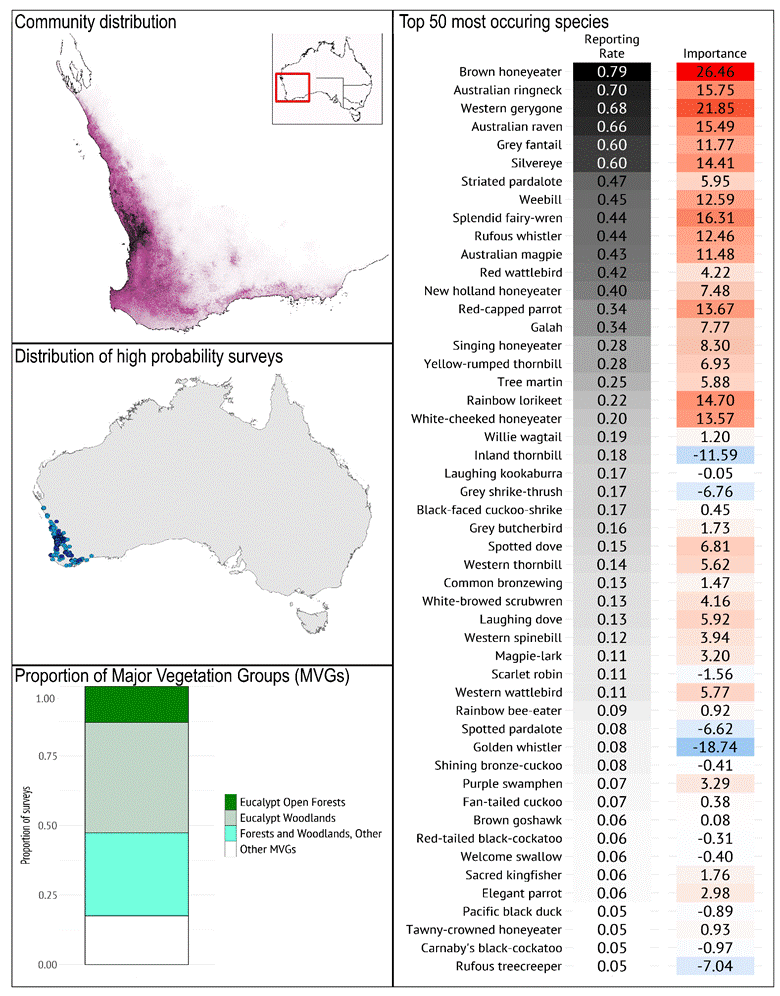
The South-western Woodland bird community occurs in the south-western corner of Western Australia, extending from near Shark Bay in the north, around the south-west corner and finishing (sparsely) around Cape Arid.
Species composition
Typical species: The South-western Woodland bird community is typified by the prevalence of Brown Honeyeater, Australian Ringneck, Western Gerygone, Australian Raven, and Grey Fantail. It is best distinguished from other bird communities in the region by the high prevalence of Brown Honeyeater. The Splendid Fairy-wren is common in the South-western Woodland bird community (in contrast to the Red-winged Fairy-wren in the South-western Forest community). In addition, the South-western Woodland bird community is distinguished from the South-western Forest community by the prevalence of the Weebill, Rufous Whistler, and Singing Honeyeater. Whilst the above differences split these two bird communities, they share similarly high prevalence of Western Gerygone, Silvereye, Grey Fantail and Australian Ringneck.
Guild structure: The South-western Woodland bird community has few Western Australian endemic species. The species with the highest reporting rate in this community have wide distributions. There is a mix of insectivores, honeyeaters and granivores, with more honeyeaters represented than in the South-western Forest bird community.
Temporal dynamics: There are some distinct seasonal movements of species endemic to this vegetation association, the most obvious being Carnaby’s Black-Cockatoo which feeds, breeds and roosts throughout this region. It is seen in large flocks in late summer and autumn and relies on banksia woodlands for feeding. The mass flowering of banksia and wandoo in late winter and spring drive an influx of nectarivores particularly the Purple-crowned Lorikeet (in wandoo woodlands) and Western Spinebill, White-cheeked Honeyeater and Tawny-crowned Honeyeater (banksia woodlands).
Geographical variation: The banksia woodlands of the Swan Coastal Plain and Kwongan proteaceous heathlands of the south-west biodiversity hotspot are typified by a distinct nectarivore-rich bird assemblage that is not well represented by the species composition of the South-western Woodland community.
Vegetation/habitat associations
The South-western Woodland bird community occurs primarily in the drier and semi-arid Eucalypt woodlands and banksia woodlands and other forests and woodlands Major Vegetation Groups (MVGs). Dominant woodland species include York Gum (E. loxophleba) and wandoo (E. wandoo). The coastal distribution is dominated by banksia woodlands (Banksia menziesii, B. attenuata and B. prionotes) including the Swan Coastal Plain of Perth which contains extensive banksia woodlands with pockets of Tuart forest and mixed occurrences of jarrah and marri. The northern and eastern parts of this vegetation complex are drier with lower woodlands and differ to the taller woodlands in the higher rainfall zones of the south-west. An iconic species that is almost entirely restricted to this vegetation system is Carnaby’s Black-Cockatoo that breeds and feeds entirely in South-western Woodlands (Saunders 1990).
Mediterranean Mallee-heath
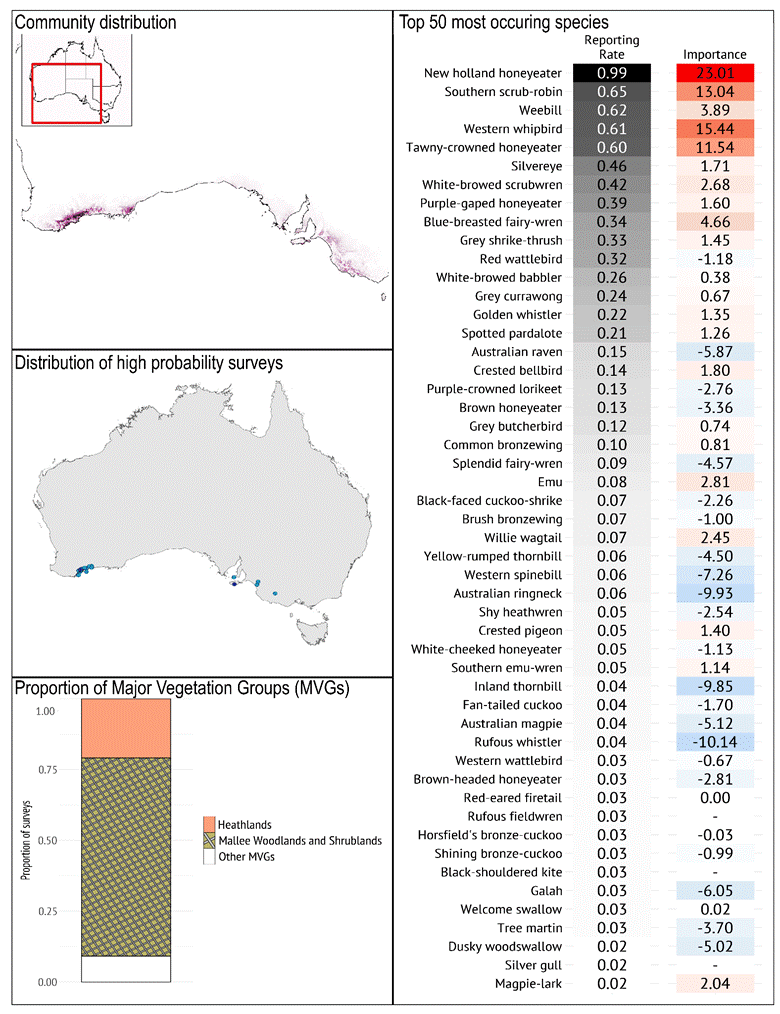
Geographical occurrence
The Mediterranean Mallee-heath bird community has a very restricted range, occurring from around Albany (WA) in the west to Jerdacuttup, then again in and around Cape Arid National Park (WA), and in SA on Kangaroo Island near Cape Gantheaume and Dudley, and on the mainland in and around Ngarkat Conservation Park, along the eastern edge of the Stirling Ranges, and in the patchy remnant vegetation near the SA/Vic border.
Species composition
Typical species: The Mediterranean Mallee-heath bird community is typified by the prevalence of New Holland Honeyeater, Western Whipbird, Southern Scrub-robin and Tawny-crowned Honeyeater. It is also distinguished from other communities in this region by the low prevalence of Rufous Whistler and Inland Thornbill (associated with drier regions), and the Australian Ringneck (associated with more forested regions).
Guild structure: The Mediterranean Mallee-heath bird community uniquely has high rates of occurrence for mesic associated shrub-dependent nectarivores such as Tawny-crowned Honeyeater and New Holland Honeyeater. In addition, mallee/heath-associated species such as Southern Scrub-robin and Western Whipbird were common in this community. In general, this community consists of species associated with dense low vegetation and eucalyptus shrublands, but not associated with taller eucalyptus woodlands and forests.
Temporal dynamics: Fires and post-fire succession are important in the vegetation that supports this community. Wildfires are often severe and stand-replacing (Burbidge et al. 2007). Due to the strong influence of such fires on vegetation structure and food resources, the composition of the community varies with time since the last fire (Rainsford et al. 2021). The first few years post-fire are dominated by species associated with open vegetation, whereas shrub-associated species increase in occurrence after this time, once low and dense vegetation has returned (Makdissi et al. 2024).
Geographical variation: There is some geographical variation for this community due to a distribution that spans western Australia, eastern Australia and Kangaroo Island (e.g. the Blue-breasted Fairy-wren is restricted to Western Australia). The Western Ground Parrot is an extremely rare and range restricted species found around Cape Arid National Park. Although this species was too rare and secretive to influence the community typology, it is worth noting that the Western Ground Parrot is probably part of this community (Burbidge et al. 2007).
Vegetation/habitat associations
The Mediterranean Mallee-heath bird community occurs primarily in mallee woodlands, and heathlands Major Vegetation Groups (MVGs). The typical species in this community prefer low dense vegetation, diverse flowering shrub layer and the presence of shrubby (mallee) eucalyptus species. The vegetation and bird bird species associated with this bird community are distinctly more mesic than similar communities in this region (e.g. Shrubby Mallee).\
Open Mallee
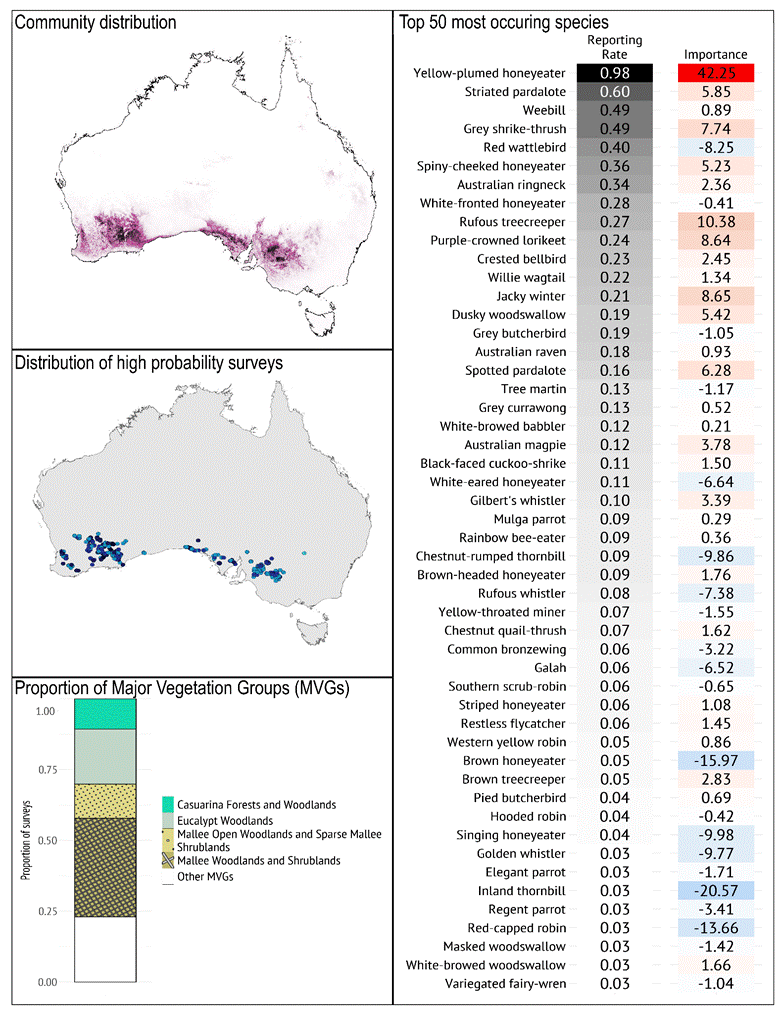
Geographical occurrence
The Open Mallee bird community (like the similar Shrubby Mallee bird community) stretches from south-west Western Australia, to western Victoria and south-west New South Wales, with its range split by the Nullarbor Plain. This community occurs in semi-arid regions with an average annual rainfall of 300-400mm. The areas with the highest probability of this community occurring include areas where more remnant vegetation remains such as Norseman and surrounds (WA), the Bookmark Biosphere Reserve (SA) and Murray Sunset National Park (Victoria).
Species composition
Typical species: When intact, this community is distinguished by the presence of the closely mallee-associated Yellow-plumed Honeyeater (by far the most important indicator for this community), Rufous Treecreeper, Jacky Winter, Purple-crowned Lorikeet and Grey Shrike-thrush.
Guild structure: Although Shrubby Mallee and Open Mallee bird communities had similar distributions, their guild structures differed substantially. Open Mallee had higher rates of occurrence for species associated with taller mallee woodlands (Yellow-plumed Honeyeater, Striated Pardalote, Grey Shrike-thrush, Jacky Winter, Spiny-cheeked Honeyeater and Rufous Treecreeper).
Temporal dynamics: Fires and post-fire succession are important in the vegetation that supports this community (Taylor et al. 2012; Gosper et al. 2019). Wildfires are often severe and stand-replacing (Clarke et al. 2021). Due to the strong influence of such fires on vegetation structure and food resources, the composition of the community varies with time since the last fire (Gosper et al. 2019). Regenerating mallee vegetation can form a low and dense shrubland in the first 10 years after fire, resulting in an increased prevalence in shrub-associated bird species (Rainsford et al. 2020, 2023). Whereas in mature Open Mallee, there is a mostly open understorey and taller mallee Eucalyptus canopy, with a mix of bareground and deep leaf litter around the bases of trees. As a result, litter foraging, bark foraging and canopy foraging species are more common in mature Open Mallee (Gosper et al. 2019).
Geographical variation: In the west, the Rufous Treecreeper is common but this is replaced by Brown Treecreeper in the east. The Brown Treecreeper remains a positive indicator of this community despite its overall low rate of occurrence. Although not shown in the typology, the Open Mallee bird community is likely to comprise multiple rare and threatened mallee specialist bird species in the eastern mallee (Boulton et al. 2021; Verdon & Clarke 2022).
Vegetation/habitat associations
The Open Mallee bird community occurs primarily in mallee woodlands, and Eucalypt woodlands Major Vegetation Groups (MVGs), where the understorey is moderately open, comprising shrubs and hummock-grass (Triodia spp.) and the ground layer comprises a mix of bareground and deep litter at the bases of trees. As a result, most species associated with this community forage in the canopy and bark of taller mallee trees, with occasional ground foraging species associated with leaf litter (e.g. Chestnut Quail-thrush).
Shrubby Mallee
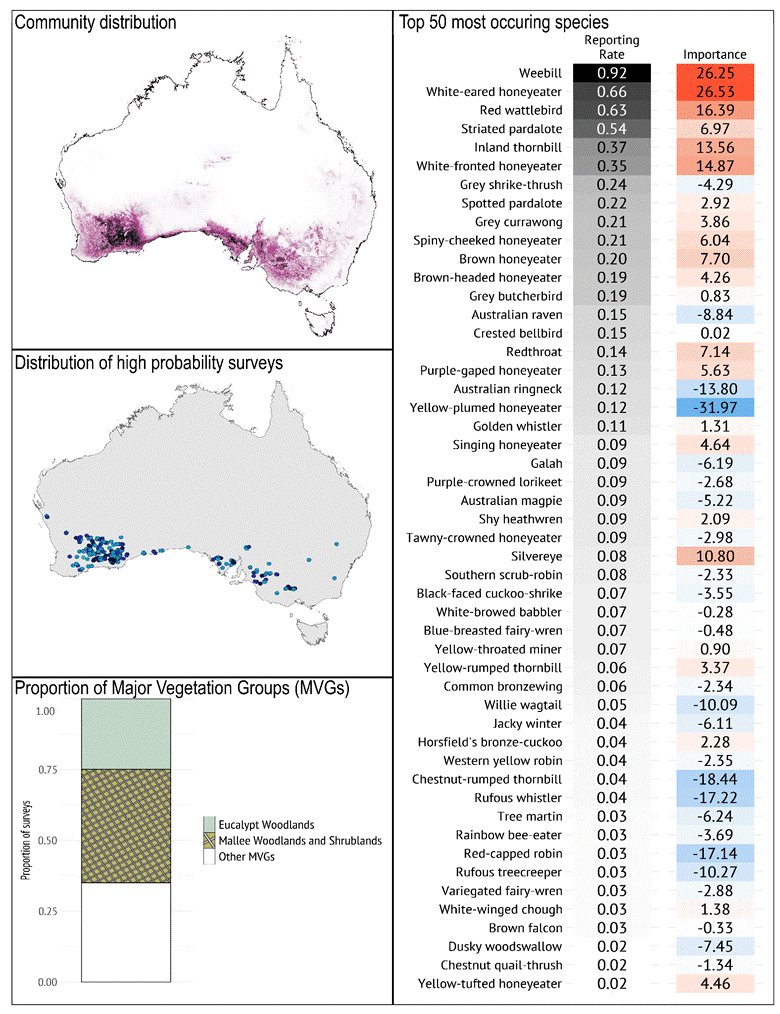
Geographical occurrence
The Open Mallee and Shrubby Mallee bird communities both stretch from south-west Western Australia, to western Victoria and south-west New South Wales, interrupted by the Nullarbor Plain. They occur in semi-arid regions with an annual average of 300-400mm of rain. The Shrubby Mallee community is less likely to occur in the eastern extent of its range than the Open Mallee community and has a higher occurrence in Norseman and surrounds. In its eastern extent, the Shrubby Mallee community occurs further south than the Open Mallee community.
Species composition
Typical species: The Shrubby Mallee bird community is typified by high prevalence of Weebill, White-eared Honeyeater, Red Wattlebird, Inland Thornbill and White-fronted Honeyeater. The relatively low rate of occurrence of Yellow-plumed Honeyeater (compared to Open Mallee) is an important distinguishing feature of the Shrubby Mallee community.
Guild structure: Although Shrubby Mallee and Open Mallee bird communities had similar distributions, their guild structures differed substantially. Shrubby Mallee had higher rates of occurrence for shrub associated species (e.g. White-eared Honeyeater, Inland Thornbill and White-fronted Honeyeater) and lower rates for many of the woodland associated species that define the Open Mallee community (e.g. Grey Shrike-thrush, Australian Ringneck, Rufous Whistler, Rufous Treecreeper). The Redthroat is another uncommon shrub-dwelling species that is more likely to occur in this community than Open Mallee.
Temporal dynamics: Fires and post-fire succession are important in the vegetation that supports this community. Wildfires are often severe and stand-replacing (Clarke et al. 2021). Due to the strong influence of such fires on vegetation structure and food resources, the composition of the community varies with time since the last fire (Makdissi et al. 2024). After a brief period that favours open habitat species such as the Yellow-rumped Thornbill, regenerating Shrubby Mallee supports a diverse and often dense shrub layer with many species providing important nectar resources. This regenerating vegetation can form a low and dense shrubland in the first 10 years after fire, resulting in an increased prevalence in shrub-associated bird species (Clarke et al. 2021). Mature Shrubby Mallee still supports a diverse bird assemblage. However, after longer fire-free periods (e.g. > 40 yrs), the vegetation can senesce, becoming open and less diverse, resulting in decreased bird abundance and richness (Verdon et al. 2024; Makdissi et al. 2024). Alternatively, the absence of fire can also allow monotypic stands of the inland pine Callitris spp. to develop, resulting in a bird community with different characteristics and generally lower richness (Bradstock et al. 2006).
Geographical variation: Although this community spans Western and Eastern Australia, most important species occur on both sides of the Nullarbor Plain, resulting in limited geographic variation in the Shrubby Mallee community. Some rare, range restricted species are associated with this community in eastern Australia. Although they are not represented in the typology due to their rarity (e.g. Mallee Emu-wren and Red-lored Whistler; Verdon et al. 2024).
Vegetation/habitat associations
The Shrubby Mallee bird community (like the Open Mallee bird community) occurs primarily in mallee woodlands, and Eucalypt woodlands Major Vegetation Groups (MVGs) with mallee-type trees and a well-developed shrub layer. In general the mallees form a low shrubland or open shrubland rather than a taller woodland. In addition, Shrubby Mallee supports a more diverse and structurally important layer of flowering shrub species, resulting in a greater prevalence of nectarivorous Honeyeaters (e.g. White-fronted Honeyeater and Purple-gaped Honeyeater).
Inland Woodland with Eucalypt
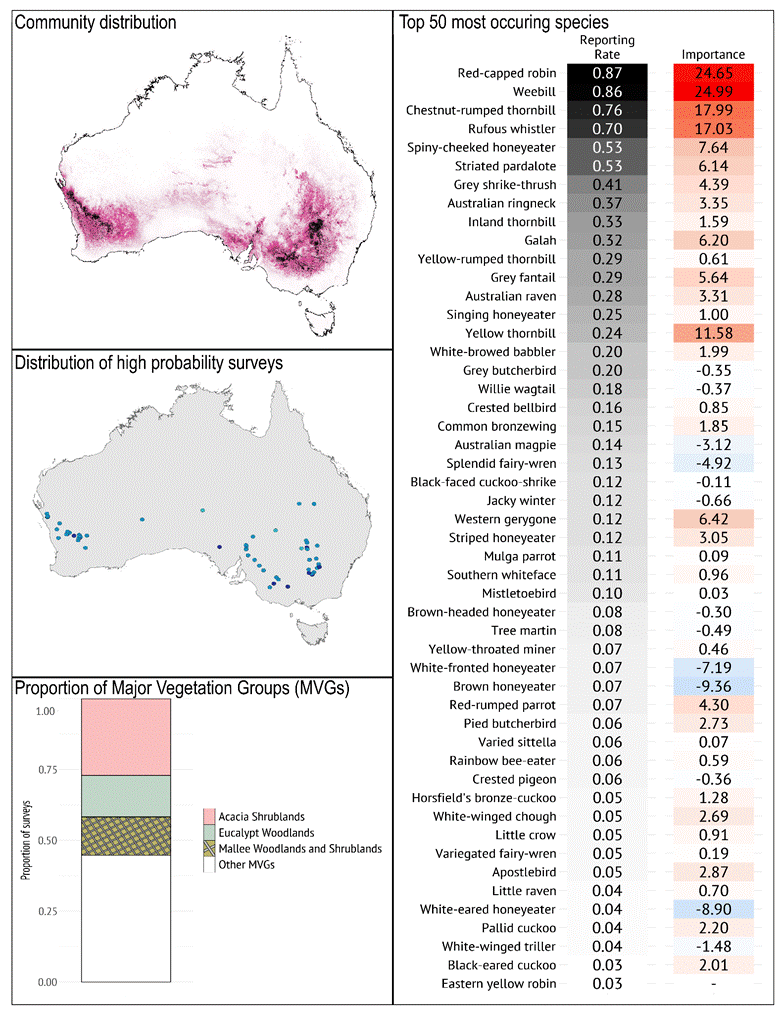
Geographical occurrence
The Inland Woodland with Eucalypt bird community has a similar pattern of occurrence to the Mulga bird community, spanning areas with between 300 and 600mm rainfall, primarily in winter, as high as Carnarvon (WA) and Jundah (QLD). The highest probability of occurrence for this community is around the junction of the Darling and Bogan Rivers (NSW) and the Murray-Sunset National Park (Vic), and along the series of almost-connecting lakes and waterways along the eastern fringe of the WA Wheat/Sheep belt (WA).
Species composition
Typical species: The Inland Woodland with Eucalypt bird community is typified by the prevalence of Red-capped Robin, Weebill, Chestnut-rumped Thornbill, Rufous Whistler and Spiny-cheeked Honeyeater. Its species composition is most similar to the Mulga bird community, sharing the distinctive high prevalence of Chestnut-rumped Thornbill, Red-capped Robin, and Spiny-cheeked Honeyeater. It is distinct from the Mulga bird community in having a higher prevalence of Weebill, Striated Pardalote, Rufous Whistler, and Grey Shrike-thrush and lower prevalence of Splendid Fairy-wren.
Guild structure: The Inland Woodland with Eucalypt is dominated by small to medium insectivores, with a relatively low diversity and prevalence of nectarivores and few granivores.
Temporal dynamics: In northern NSW and southern QLD, variable summer rainfall is a primary driver of sparse Acacia dominated Mulga vegetation community, while infrequent fire (inter-fire interval 40 – 50 years) is a driver of eucalypt-dominated systems in more Mediterranean parts of this distribution. When fire-sensitive Acacia shrublands are burned, the bird community typical of inland Eucalypt woodlands is likely to shift significantly, with a greater representation of generalist species for 10–15 years post-fire (Woinarski 1999).
Geographical variation: The majority of the important species in this typology span eastern and western Australia. The Yellow Thornbill and Red-rumped Parrot are representative of the eastern taxa.
Vegetation/habitat associations
The Inland Woodland with Eucalypt bird community occurs primarily in Acacia shrublands, and Eucalypt woodlands Major Vegetation Groups (MVGs). Locations situated in the drier regions of the geographical range are characterised by multi-stemmed, low Acacia shrubs (<2 m), while in more mesic parts of the distribution give way to single-stemmed acacia of greater height (<6 m). In eucalypt-dominated systems, trees are widely spaced with a ground layer that is dominated by tussock grasses with forbs in south-eastern Australia, while being relatively sparse in south-western Australia. Acacia or Callitris may occur in a subcanopy, providing key resources for gleaning insectivores (Pavey & Nano 2009).
Mulga
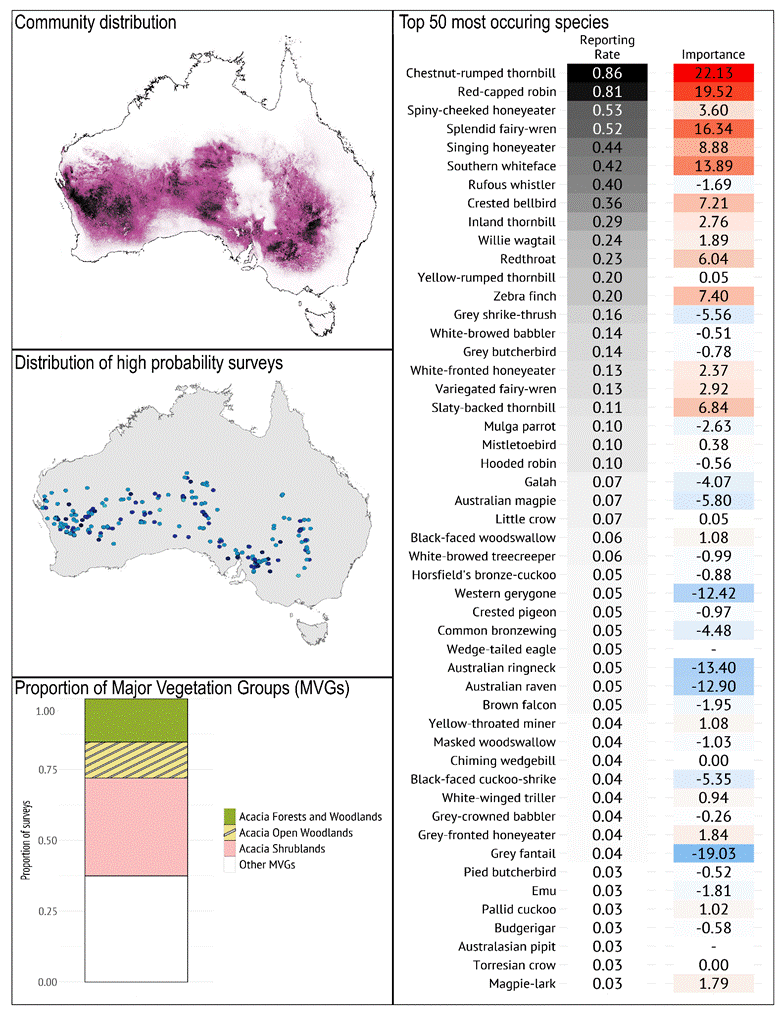
Geographical occurrence
The distribution of the Mulga bird community corresponds with the mapped distribution of mulga Acacia aneura shrublands (Eamus et al. 2016). The Mulga bird community has a similar pattern of occurrence to the Inland Woodland with Eucalypt bird community, but includes areas further north. It spans areas with between 200 and 600 mm rainfall, primarily in winter, as far north as Exmouth (WA) and McKinlay (QLD). It has the same occurrence hotspots to the Inland Woodland with Eucalypt bird community, but extending in a wider radius around the same points: the junction of the Darling and Bogan Rivers (NSW) and the Murray-Sunset National Park (Vic), and along the series of almost-connecting lakes and waterways along the eastern fringe of the WA Wheat/Sheep belt (WA). It also has a high occurrence in the Maralinga Tjarutja lands and surrounds (SA).
Species composition
Typical species: The Mulga bird community is typified by the prevalence of Chestnut-rumped Thornbill, Red-capped Robin, Spiny-cheeked Honeyeater, Splendid Fairy-wren, and Singing Honeyeater. Its species composition is most similar to the Inland Woodland with Eucalypt bird community, sharing distinctive high prevalence of Chestnut-rumped Thornbill, Red-capped Robin, and Spiny-cheeked Honeyeater. It is distinct from the Inland Woodland with Eucalypt bird community in its higher prevalence of Splendid Fairy-wren and Inland Thornbill and lower prevalence of Weebill, Striated Pardalote, Rufous Whistler, and Grey Shrike-thrush. Redthroat and Slaty-backed Thornbill are characteristic species of more intact sites.
Guild structure: The community is dominated by a diversity of small- to large-bodied insectivores that forage at various strata from the ground to the canopy, which is a consistent finding with avifauna studies in mulga habitats (Recher & Davis Jr 1997; Recher 2018); the common honeyeaters (Spiny-cheeked and Singing) are quite insectivorous.
Temporal dynamics: The Mulga bird community appears to exhibit relatively little seasonal variation across a year as compared with other dryland bird communities (Cody 1994; Reid et al. 2024). But is sensitive to large climatic changes, with wet conditions driving an influx of migratory and nomadic birds which are largely absent in dry conditions (Recher 2018).
Geographical variation: Species composition varies slightly depending on the available species pool in the area, variation in mulga stands and their position in the landscape (Burbidge et al. 2000, 2010). Slaty-backed Thornbill and White-browed Treecreeper, for example, have a narrower distribution than that of the community.
Vegetation/habitat associations
The Mulga bird community occurs primarily in Acacia shrublands, and Acacia forests and woodlands Major Vegetation Groups (MVGs) – essentially, those dominated by Mulga A. aneura.

