This region consists of three bird communities, Inland Treed Water Source, South-eastern Open Box-Gum Woodland, and South-eastern Woodland Inland Slopes. These communities clustered most closely to many of the community types that were deemed anthropogenic or ‘degraded’. They share species that often occur in open modified environments, such as Willie Wagtail, Australian Magpie and Galah. The geographic location and the types of woodlands/forests in which these communities occur differ substantially and can be considered in two parts.
The Inland Treed Water Source community occurs in dry environments extending across much of arid and semi-arid Australia, but within this broad area the community is restricted mainly to open woodlands associated with creeks, drainage lines, flood plains and water points (both natural and anthropogenic). Suitable habitat often is limited in size, such as linear strips of River Red Gum woodland along creeklines, with adjacent vegetation being structurally distinct (e.g. chenopod shrublands). The woodland habitat supports characteristic species that forage in the tree canopy (e.g. White-plumed Honeyeater, Black-faced Cuckoo-Shrike, Yellow-throated Miner), nest in tree hollows (Galah, Australian Ringneck) or favour elevated perch sites (Pied Butcherbird, Whistling Kite, Black Kite). The core elements of this community are relatively stable throughout the year. Drought is a primary environmental disturbance factor, and the woodlands and shrublands that support this community may serve as a refuge for a wider range of species during severe drought.
The South-eastern Woodland Inland Slopes community and the South-eastern Open Box-Gum Woodland community both occur in temperate south-eastern Australia. The South-eastern Woodland Inland Slopes community occurs mainly on the inland slopes of the Great Dividing Range, on gentle slopes and hills, often on nutrient-poor soils. This bird community occupies dry forests and woodlands, commonly with a shrubby understorey. The South-eastern Open Box-Gum community commonly occurs on the flatter plains on more-fertile soils, including moister woodlands along creeklines and floodplains. These woodlands typically have a more-open, grassy ground layer and lower density of trees; and give way to open woodlands and native grasslands.
South-eastern Open Box-Gum Woodland and South-eastern Inland Slopes Woodland bird communities share species that are widespread in woodlands and dry forests of south-eastern Australia (e.g. Grey Shrike-thrush, Superb Fairy-wren, Rufous Whistler, Striated Pardalote, White-winged Chough, Black-faced Cuckoo-shrike), but each also has distinctive elements associated with differences in landform, vegetation types and the dominant eucalypt species. These communities change in composition through the year as a result of an influx of spring-summer migrants from the north (e.g. Sacred Kingfisher, White-browed Woodswallow, Pallid Cuckoo), winter migrants from the ranges (e.g. Yellow-faced Honeyeater, White-naped Honeyeater, Flame Robin), and local seasonal variation in nectar-feeders that track eucalypt flowering (e.g. Musk Lorikeet, Red Wattlebird, Noisy Friarbird). The South-eastern Open Box-Gum Woodland bird community is especially similar to the Dry Lowland South-eastern Woodland bird community but lacks Grey Fantail and has a much lower reporting rate of Rufous Whistler.
Clearing for agriculture has had a marked effect on the distribution and abundance of species in these two communities (Robinson & Trail 1996; Paton et al. 1999; Ford et al. 2001; Radford et al. 2005; Szabo et al. 2011), particularly the South-Eastern Open Box-Gum Woodland community which occupies what has become the Sheep-Wheat Belt of south-eastern Australia. These woodlands now occur largely as remnants, large and small, within a vast sea of grazing and cropping lands. Bird communities become depleted as the amount of wooded cover in the landscape declines (Bennett & Ford 1997; Radford et al. 2005; Cunningham et al. 2014), and as remnants become degraded by stock grazing and/or loss of structural complexity (Loyn 1987; Arnold 1988). Loss and fragmentation of woodlands has greatly advantaged the Noisy Miner, a native species but despotic competitor, which has profoundly altered bird communities over vast areas of these woodlands in south-eastern Australia (Loyn 1987; Grey et al. 1998, 1998; Mac Nally et al. 2012; Maron et al. 2013). Many of the ‘declining woodland birds’ in south-eastern Australia (Reid 1999; Ford et al. 2001; Watson 2011; Bennett et al. 2024) are members of these communities. Extended drought also has a detrimental effect on these communities (Mac Nally et al. 2009; Bennett et al. 2014; Selwood et al. 2015a) especially in association with habitat loss (Haslem et al. 2015).
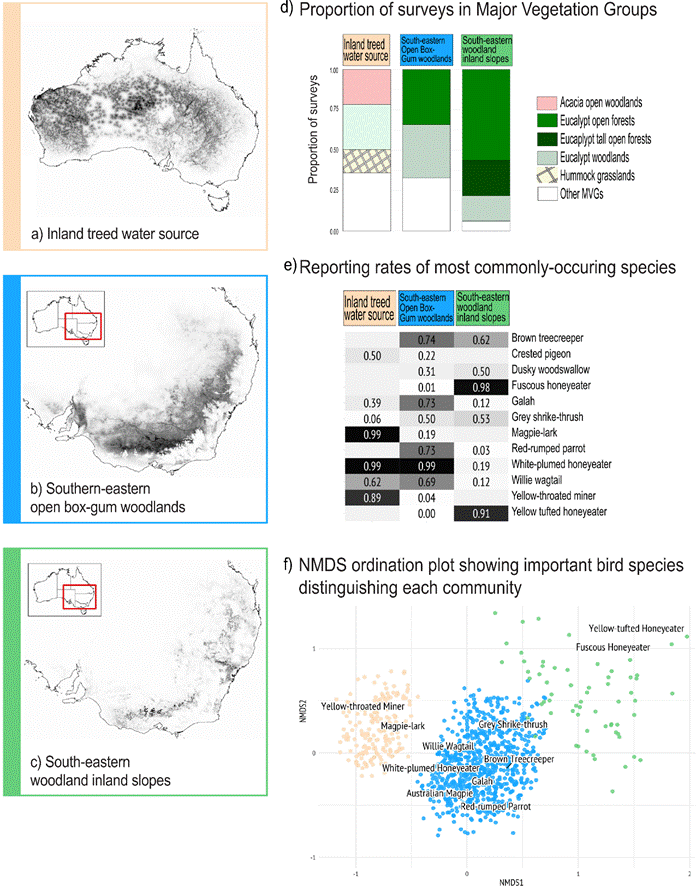
Figure Region D: a), b) and c): Inset maps show location of region, larger maps show modelled distribution of communities based on Maxent models, with darker shading representing a higher likelihood of occurrence. d) proportion of surveys in each community occurring in Major Vegetation Groups (MVGs; MVGs in which >10% of surveys were located shown). e) reporting rates (RR) of the top 5 most commonly occurring species in each community. f) Non-metric multidimensional scaling (NMDS) ordination plot depicting the location in multidimensional space of key species that distinguish communities in this region.
Inland Treed Water Source
Geographical occurrence
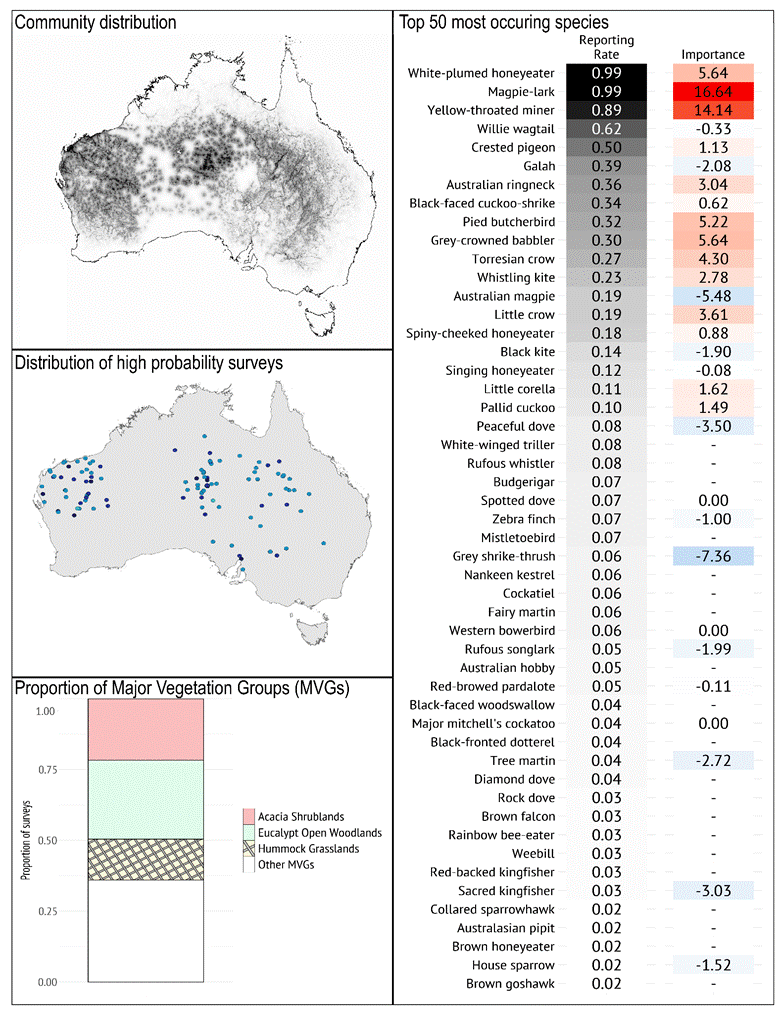
The Inland Treed Water Source bird community is spread broadly across inland Australia, associated with creeklines, floodplains and permanent or ephemeral water. This community can be found in open arid and semi-arid rangelands where there are tree-lined watercourses or (natural or artificial) watering points.
Species composition
Typical species: The Inland Treed Water Source bird community is typified by the prevalence of the White-plumed Honeyeater, Magpie-lark, Yellow-throated Miner, Willie Wagtail, and Crested Pigeon. It is best distinguished from the other communities in this region by the high prevalence of White-plumed Honeyeater, Magpie Lark, and Yellow-throated Miner.
Guild structure: This community has a small number of key species: Magpie-lark and White-plumed Honeyeater occurring in 99% of lists, and Yellow-throated Miner in 89% of lists. The ubiquity of the White-plumed Honeyeater and Yellow-throated Miner means that this community is associated with treed water sources, which often will be adjacent to structurally different vegetation types (e.g. Acacia shrublands, chenopod shrublands, grasslands) with different bird communities that may ‘spill over’ into this one. The Inland Treed Water Source community includes a range of insectivores (e.g. Black-faced Cuckoo-Shrike, Red-browed Pardalote, Grey-crowned Babbler, Rufous Whistler, White-winged Triller) and granivores (e.g. Galah, Budgerigar, Crested Pigeon, Peaceful Dove, Australian Ringneck), with lower prevalence of nectarivores indicating ephemeral nectar resources, most likely dependent on flowering seasons of red gums and bloodwoods. Larger predators, such as Whistling Kite, Black Kite, Pied Butcherbird and Little Crow, regularly use trees in this vegetation for perching, but forage widely beyond it.
Temporal dynamics: The composition of this community is largely stable, being associated with water, with relatively few migratory species (e.g. White-winged Triller, Pallid Cuckoo) and a few nomadic/irruptive species (e.g. Budgerigar). Species that distinguish this community (Australian Ringneck, Magpie-lark, Pied Butcherbird) often use floodplain habitat as refuge during drought (Selwood et al. 2015a, 2015b).
Geographical variation: As this community occurs around disjunct watering points, the composition is likely influenced by the surrounding bird communities. The core list of species that are reliant on the watering points will be supplemented by species from the surrounding communities that also utilise this key resource.
Vegetation/habitat associations
The community occurs primarily in Eucalypt woodland and open woodland Major Vegetation Groups (MVGs), associated with drainage lines (e.g. River Red Gums, Coolabahs and Bloodwoods). Other vegetation types, such as Acacia shrublands and Hummock Grasslands may occur adjacent to the watercourses.
South-eastern Open Box-Gum Woodland
Geographical occurrence
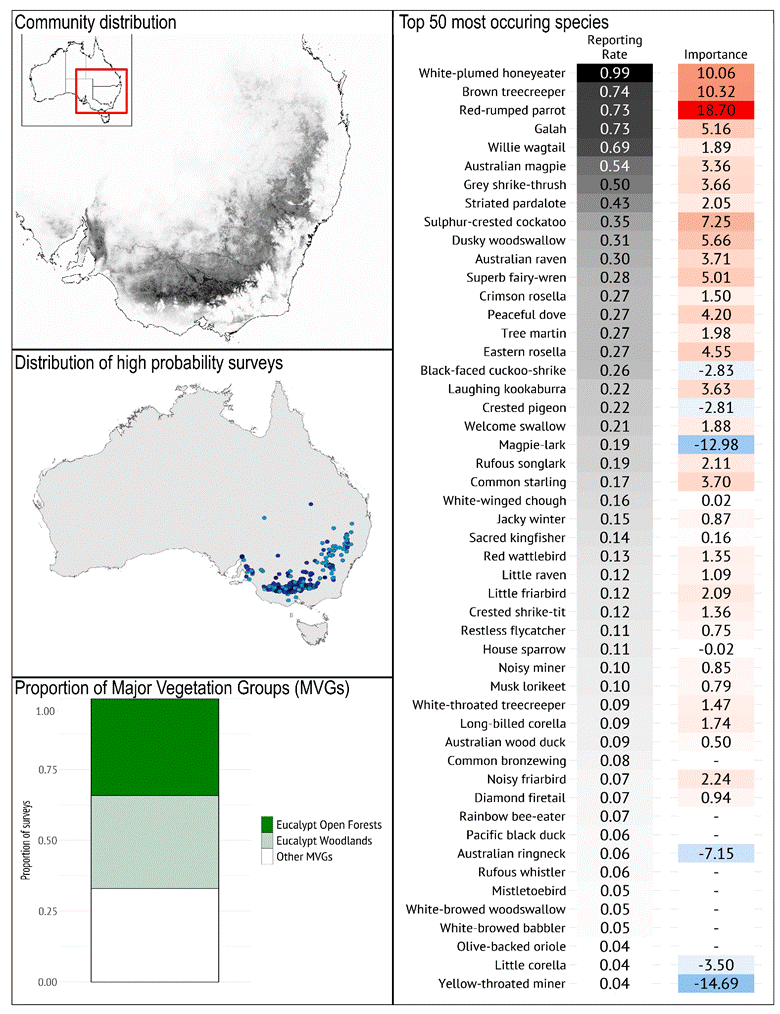
The South-eastern Open Box-Gum Woodland bird community occurs from the ranges north of Adelaide (SA), through central and northern Victoria, to inland NSW and reaching as high as Brisbane (QLD). It occurs mainly inland of the Great Dividing Range, on plains with reasonably fertile soil, in areas with between 300 and 600 mm annual rainfall; a higher probability of occurrence is associated with higher rainfall areas within that range.
Species composition
Typical species: The South-eastern Open Box-Gum Woodland bird community is typified by the prevalence of White-plumed Honeyeater, Brown Treecreeper, Galah, Red-rumped Parrot, Willie Wagtail, Australian Magpie, Grey Shrike-thrush and Striated Pardalote. It is best distinguished from other communities in this region by the high prevalence of Galah and Red-rumped Parrot, and the absence of Fuscous and Yellow-tufted Honeyeaters.
Guild structure: This community occurs in woodland habitats of the plains (e.g. box woodlands) and associated stream systems (e.g. River Red Gum woodlands), typified by numerous hollow-bearing trees. Consequently, a distinctive feature of this community is the diversity of hollow-nesting species including parrots and cockatoos (e.g. Eastern Rosella, Sulphur-crested Cockatoo, Red-rumped Parrot, Galah) and other species (Brown Treecreeper, Sacred Kingfisher, Laughing Kookaburra, Striated Pardalote) (Loyn 1985; Lunt & Bennett 2000). The open ground layer is likely maintained in some areas through grazing and, though it allows a range of ground-foraging species, the most prevalent species are resilient to grazing (e.g. insectivores: Willie Wagtail, Australian Magpie, Restless Flycatcher, Jacky Winter, and granivores: Red-rumped Parrot, Peaceful Dove, Galah, Diamond Firetail) (Antos & Bennett 2005, 2006). This community includes a number of species of conservation concern, listed as ‘declining’ woodland birds (e.g. Diamond Firetail, Brown Treecreeper, Jacky Winter, Dusky Woodswallow) (Reid 1999; Watson 2011; Bennett et al. 2024). A characteristic species of this community, the White-plumed Honeyeater, is a canopy-feeding species that is particularly widespread and abundant in streamside River Red Gum vegetation. Where it is common, it may exclude small insectivores, such as thornbills and whistlers.
Temporal dynamics: Spring-summer visitors to this community include Rufous Songlark, Sacred Kingfisher, Rainbow Bee-eater, White-browed Woodswallow, Olive-backed Oriole. The local abundance of nectar-feeders (e.g. Red Wattlebird, Noisy Friarbird, Musk Lorikeet) can vary greatly depending on the flowering patterns of dominant eucalypt species.
Geographical variation: There is no substantial geographic variation in species composition throughout the extent of this community.
Vegetation/habitat associations
The South-eastern Open Box-Gum Woodland bird community occurs primarily in Eucalypt open forests, and Eucalypt woodlands Major Vegetation Groups (MVGs), on relatively fertile soils of plains and lower slopes. This includes forests and woodlands along streams, rivers and floodplains, characterised by River Red Gum; and box-dominated woodlands of the plains (e.g. Grey Box E. microcarpa, Yellow Box E. melliodora, White Box E. albens and Yellow Gum E. leucoxylon). The ground layer typically is open and grassy with relatively few shrubs. These latter box-dominated woodlands are now largely cleared for agriculture: small remnants among farmland and along roadsides commonly dominated by the Noisy Miner, which aggressively excludes small insectivores.
South-eastern Woodland Inland Slopes
Geographical occurrence
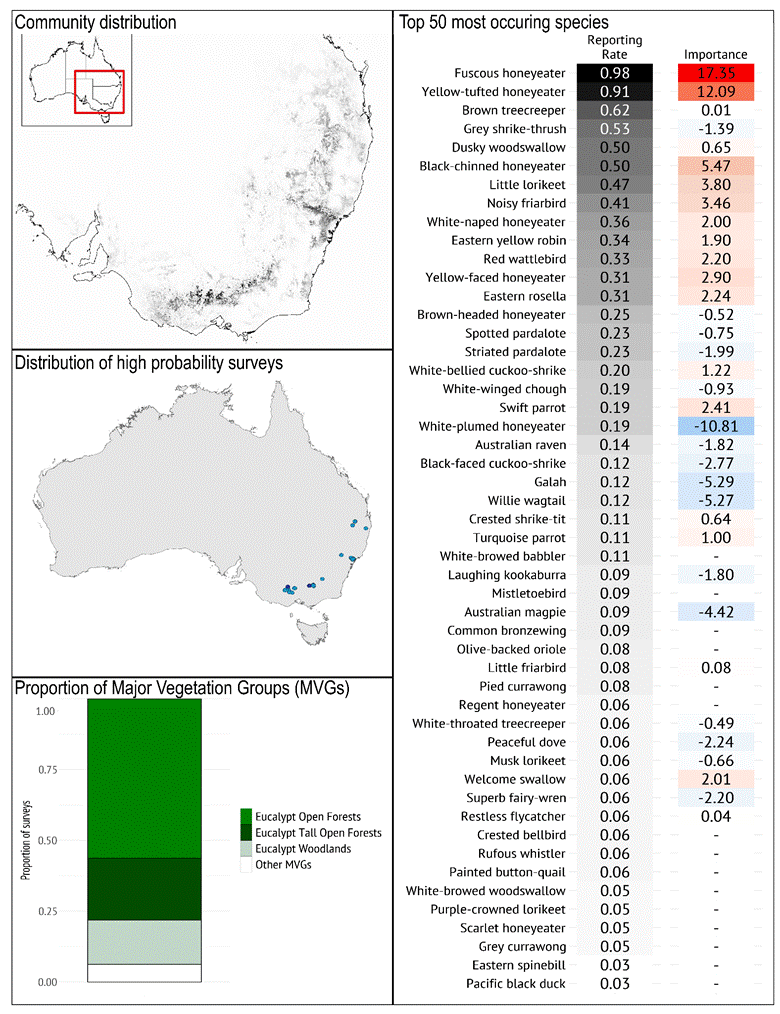
The South-eastern Woodland Inland Slopes bird community is sparsely distributed along the Great Dividing Range and inland slopes in Victoria and New South Wales, with hotspots around Bendigo and Heathcote (Vic), Wangaratta (Vic) and Wodonga (Vic)/Albury (NSW), and the Hunter Valley (NSW).
Species composition
Typical species: The South-eastern Woodland Inland Slopes bird community is typified by the prevalence of the Fuscous Honeyeater, Yellow-tufted Honeyeater, Brown Treecreeper, Grey Shrike-thrush, Dusky Woodswallow, Brown-headed Honeyeater and Black-chinned Honeyeater. It is best distinguished from other bird communities in the region by the high prevalence of Fuscous Honeyeater and Yellow-tufted Honeyeater, and the relatively low prevalence of Crested Pigeon, Galah, White-plumed Honeyeater, and Willie Wagtail.
Guild structure: A characteristic feature of this bird community is the diversity and abundance of nectar-feeding species (honeyeaters, lorikeets, friarbirds), which have a strong influence on the spatio-temporal dynamics of the community (Mac Nally & McGoldrick 1997; McGoldrick & Mac Nally 1998; Radford & Bennett 2007).
The shrubby ground layer provides habitat for species that use low shrub cover (e.g. White-browed Babbler, Superb Fairy-wren, Speckled Warbler, Crested Bellbird); whereas there tends to be fewer ground-foraging insectivores (such as Buff-rumped Thornbill, Scarlet Robin) than in more open woodlands. Seed-eating birds are scarce in this community (Loyn 1985).
Temporal dynamics: Spring-summer migrants include White-browed Woodswallow, Olive-backed Oriole and Sacred Kingfisher, but do not make up a major component of the community. Resident nectarivores (e.g. Red Wattlebird, Musk Lorikeet, Little Lorikeet, Fuscous Honeyeater, Yellow-tufted Honeyeater) move within the forests, depending on flowering patterns, and are particularly abundant in years when winter-flowering eucalypts (e.g. Red Ironbark E. tricarpa, Mugga Ironbark E. sideroxylon, Yellow Gum E. leucoxylon) flower heavily. In such years, other nectarivores may migrate into the system from forests of the Great Dividing Range (e.g. White-naped Honeyeater, Yellow-faced Honeyeater, Eastern Spinebill) or from elsewhere (Noisy Friarbird). In years when these tree species flower sparsely, or not at all, there is a mass movement of nectarivores out of the ecosystem (Mac Nally et al. 2009).
The critically endangered Swift Parrot migrates annually from Tasmania, often occurring in this community over winter months, tracking variable nectar and lerp resources (Mac Nally & Horrocks 2000). The spatiotemporal breeding and foraging patterns of the critically endangered Regent Honeyeater are also influenced by flowering patterns in this community (Franklin et al. 1989; Crates et al. 2017). Periods of severe drought (impacting resource availability) in this community have caused wide scale declines across guilds, which can persist post-drought (Mac Nally et al. 2009, 2020).
Geographical variation: There is no substantial geographic variation in species composition throughout the extent of this community
Vegetation/habitat associations
The South-eastern Woodland Inland Slopes bird community occurs primarily in Eucalypt open forests, and Eucalypt woodlands Major Vegetation Groups (MVGs). These dry forests and woodlands occur on inland slopes and hills, typically on nutrient-poor soils with low water-holding capacity. Termed ‘box and ironbark’ forests, these vegetation types include a range of eucalypt species that vary in composition depending on topographic position. Ironbarks (e.g. Red Ironbark, Mugga Ironbark) together with species such as Red Stringybark and Red Box, typically occur on dry slopes; whereas Grey Box and Yellow Gum occur on lower slopes. The understorey typically is shrubby, including Acacia spp and a range of sclerophyllous shrubs. Groundstorey (e.g. litter depth and cover, coarse woody debris cover and density) and understorey features (e.g. shrub cover) are important elements affecting species occurrence in these woodlands, providing foraging, shelter and nesting resources (Yen et al. 2011). These vegetation types have been highly impacted by clearing for agriculture, causing a high-degree of habitat fragmentation and vegetation degradation, which have interacted with the pressures of Noisy Miners and climate-drying to substantially impact flowering and resource availability, and hence bird community composition, richness and breeding (Radford & Bennett 2007; Mac Nally et al. 2009; Bennett et al. 2014).

