The Arid Zone region consists of six bird communities Arid Open Grassland with Low Shrubs, Arid Open Grassland with Sparse Trees, Arid Shrubby Woodland, Arid Woodland, General Arid Zone, and Inland Nomad. Acacia and Chenopod shrublands and hummock grasslands Major Vegetation Groups (MVGs) dominate this region, with forest/woodland MVGs more common in Arid Open Grassland with Sparse Trees, Arid Woodland, Inland Nomad and, to a lesser extent, Arid Shrubby Woodland bird communities. Community composition can be spatially and temporally dynamic across the arid zone, particularly in relation to rainfall (Burbidge & Fuller 2007; Tischler et al. 2013) and presence of large trees on watercourses can have over-riding effects on species occurrence (Pavey & Nano 2009; Smith 2015). Where water courses are heavily treed, the bird community is likely to be classified into Region D’s inland Treed Water Source community.
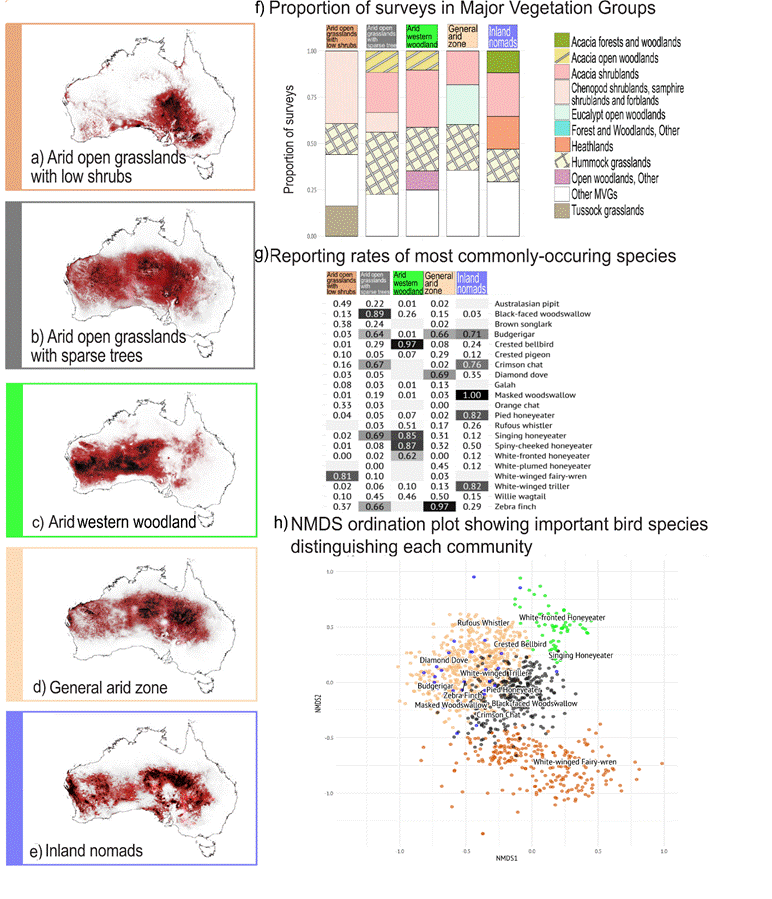
Figure Region C: a) to e): Inset maps show location of region, larger maps show modelled distribution of communities based on Maxent models, with darker shading representing a higher likelihood of occurrence. f) proportion of surveys in each community occurring in Major Vegetation Groups (MVGs; MVGs in which >10% of surveys were located shown). g) reporting rates (RR) of the top 5 most commonly occurring species in each community. h) Non-metric multidimensional scaling (NMDS) ordination plot depicting the location in multidimensional space of key species that distinguish communities in this region.
Arid Open Grassland with Low Shrubs
Geographical occurrence
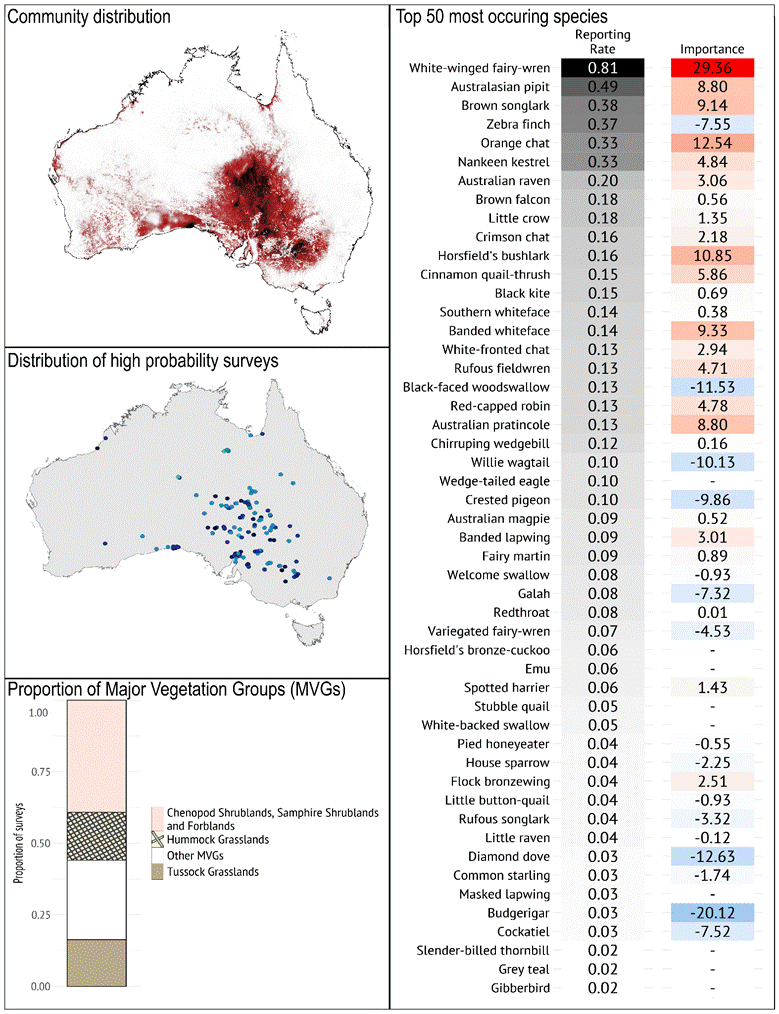
The Arid Open Grassland with Low Shrubs bird community primarily occurs across arid southern and east-central Australia in the Central Lowlands. The areas where this community is most likely to occur are around the Nullabor Wilderness protected area on the Nullarbor Plain (SA), the gibber plains of Sturts Stony Desert, and across the Simpson and Strzelecki Deserts. It includes the species-poor assemblages in the Simpson–Strzelecki Dunefields bioregion, both in the sandridge deserts themselves and the drier, outer floodplains of the LEB rivers (Reid 1990), as well as the treeless steppes of the Nullarbor Plain (Brooker et al. 1979; McKenzie & Robinson 1987), but also extends to the drier western parts of the Murray-Darlin Basin.
Species composition
Typical species: The Arid Open Grassland with Low Shrubs bird community is typified by the prevalence of White-winged Fairy-wren, Australasian Pipit, Brown Songlark, Zebra Finch, and Orange Chat. It is best distinguished from other arid zone communities by the presence of White-winged Fairy-wren, Orange Chat, Horsfield’s Bushlark and Banded Whiteface. Tall shrubland- and woodland-dependent species are largely absent from this community.
Guild structure: This community is dominated by ground feeders: insectivores (e.g. Australasian Pipit, Brown Songlark, Rufous Fieldwren); raptors (e.g. Brown Falcon, Nankeen Kestrel, Black Kite); omnivores (corvids, wedgebills, whitefaces, Horsfield’s Bushlark, Crimson Chat, Cinnamon Quail-thrush); and the generalist arid-zone graminivore, Zebra Finch. Nectar-feeding honeyeaters are scarce except in good seasons.
Temporal dynamics: Given the paucity of larger shrubs and trees in these landscapes, bird communities are depauperate in truly sedentary bird species, and so community composition appears especially dynamic depending on seasonal conditions, i.e. the influx of nomadic species after large rainfall and flooding events can outnumber the few residents (Reid 1990). Sparse sedentary Red-capped Robin and Willie Wagtail populations are boosted in autumn-winter by migrants from southern Australia.
Geographical variation: The Cinnamon Quail-thrush in the Lake Eyre Basin is replaced by the Nullarbor Quailthrush on the Nullarbor Plain, while the Chiming Wedgebill replaces the Chirruping Wedgebill in western parts of the Simpson Desert and the stony deserts west of lakes Eyre and Torrens. The quail-thrushes, wedgebills, Inland Dotterel, Gibberbird and Banded Whiteface are confined to the arid portions of the mapped community extent.
Vegetation/habitat associations
The Arid Open Grassland with Low Shrubs bird community is spread relatively evenly across chenopod (including samphire) low shrublands and forblands; hummock grasslands (often dominated by Sandhill Canegrass Zygochloa paradoxa); and tussock grasslands Major Vegetation Groups (MVGs). Three plant families dominate numerically the flora of these MVGs, namely Asteraceae, Chenopodiaceae and Poaceae, and annual and short-lived members of the Brassicacea and Fabaceae are also prominent (Mollenmans et al. 1984).
Arid Open Grassland with Sparse Trees/Tall Shrubs
Geographical occurrence
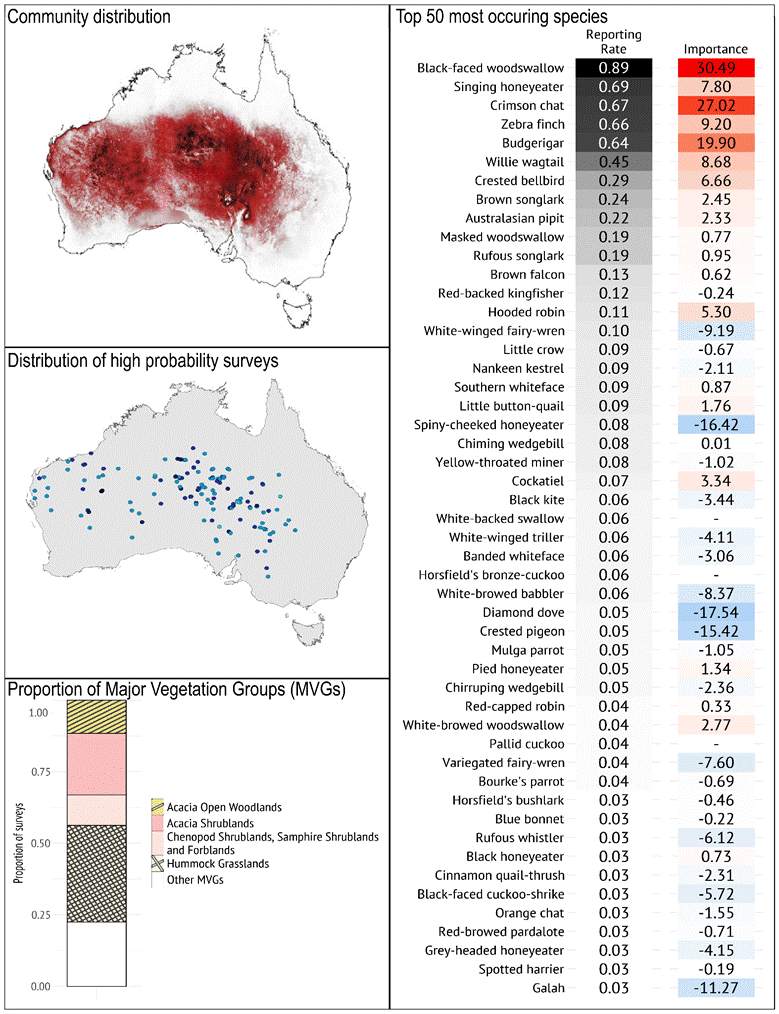
The Arid Open Grassland with Sparse Trees bird community is widespread across arid Australia in a broad band, stretching from the Pilbara region to Jilbadji Nature Reserve in Western Australia and across central Australia to Dutton River (QLD) and Broken Hill (NSW). Its distribution is notably similar to that of the General Arid Zone bird community, though it covers a wider area, including a broader southerly extent. The areas with the highest probability of this community occurring are areas away from watering points and natural sources of fresh water, i.e. in true desert and salt lake regions, including Tjoritja / West MacDonnell National Park in the Northern Territory (and surrounding ranges), around Lakes Frome, Blanche, and Eyre in South Australia, and Lake Disappointment, Dora and other salt lakes spread across Western Australia.
Species composition
Typical species: The Arid Open Grassland with Sparse Trees bird community is typified by the prevalence of Black-faced Woodswallow, Singing Honeyeater, Crimson Chat, Zebra Finch, and Budgerigar. It is best distinguished from the other arid zone communities by the high reporting rate of Black-faced Woodswallow and Crimson Chat (also prevalent in the Inland Nomad bird community), and the relatively low reporting rate of larger water-dependent species (Crested Pigeon and Galah), and species preferring denser, shrubbier vegetation (Purple-backed Fairy-wren, Spiny-cheeked Honeyeater, Rufous Whistler and White-browed Babbler).
Guild structure: The majority of species in the Arid Open Grassland with Sparse Trees bird community prefer open habitats including ground-foraging insectivores (e.g. Crimson Chat, Willie Wagtail), granivores (e.g. Zebra Finch, Little Button-quail), and predators (e.g. Red-backed Kingfisher, Nankeen Kestrel). However, some tree and tall shrub using/dependent species occur as well (e.g. Singing Honeyeater, Crested Bellbird, and Hooded Robin) but most of these are also ground foragers.
Temporal dynamics: Within the extensive hummock grasslands Major Vegetation Group, this bird community is typical of early, post-fire successional states, when bunch grasses and herbs predominate (Reid et al. 1993). There are relatively few migratory species although some of the common species of this community are irruptive or nomadic, with most temporal dynamics likely driven by variation in rainfall among years, as for most communities in this region.
Geographical variation: Despite the extensive distribution of this community, most of its typical species occur throughout. Exceptions include the Chiming Wedgebill which is replaced by Chirruping Wedgebill in the east.
Vegetation/habitat associations
The Arid Open Grassland with Sparse Trees bird community occurs primarily in hummock grasslands, and Acacia shrublands Major Vegetation Groups (MVGs), especially in early successional states.
Arid Western Woodland/Tall Shrubland
Geographical occurrence
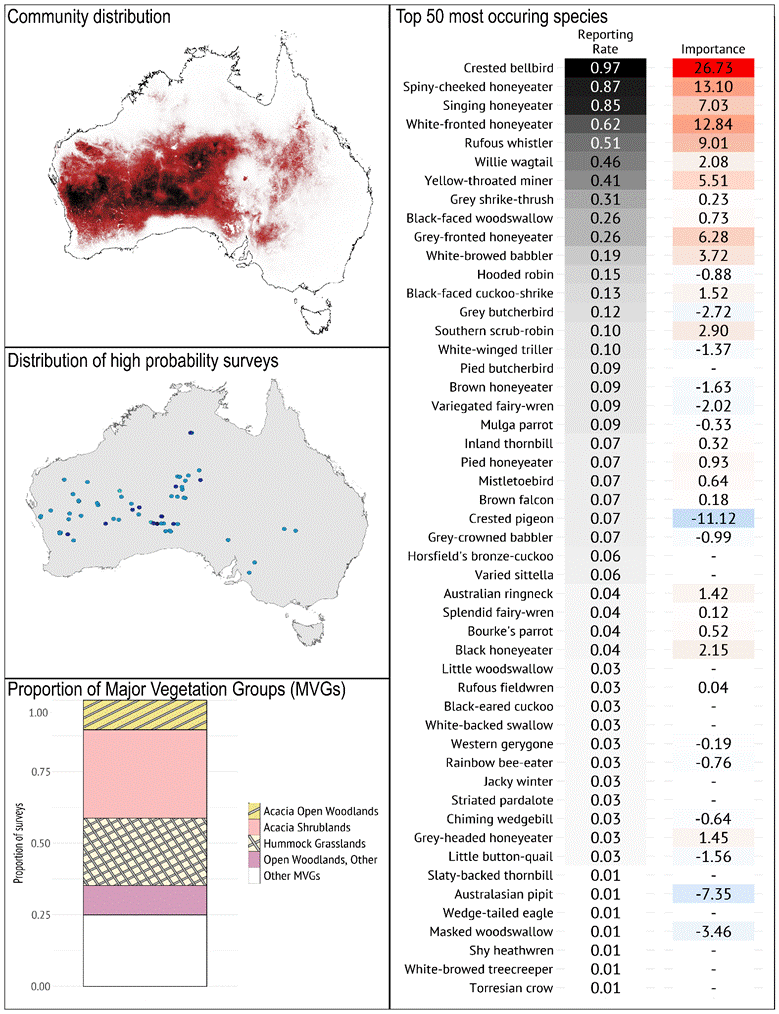
The Arid Woodland bird community occurs mainly in the central and western parts of the arid zone of Australia from Mount Sheila and Bridgetown in Western Australia to the edge of the Simpson and Strezlecki deserts in the east, especially in areas with approximately 200-300 mm annual rainfall.
Species composition
Typical species: The Arid Woodland bird community is typified by the prevalence of Crested Bellbird, Spiny-cheeked Honeyeater, Singing Honeyeater, White-fronted Honeyeater, and Rufous Whistler. The community is best distinguished from others in the Arid Zone region by the greater probability of occurrence of Crested Bellbird, Rufous Whistler and White-fronted Honeyeater, and by the low probability of occurrence for Budgerigar, Crested Pigeon, and Zebra Finch.
Guild structure: The community primarily comprises medium sized insectivores (e.g. Crested Bellbird, Rufous Whistler, Willie Wagtail) and nectarivores (e.g. Spiny-cheeked, Singing, and White-fronted Honeyeaters). The most prevalent species are strongly associated with trees and shrubs, which is fitting given its vegetation associations.
Temporal dynamics: This community includes some seasonal migrants like the White-winged Triller and Horsfield’s bronze-cuckoo and Black-eared Cuckoo. These species all migrate to southern Australia in summer (August to February) to breed, and overwinter in the inland.
Geographical variation: Southern Scrub-robin, Rufous Fieldwren and Shy Heathwren only occur in the southern examples of this community, while Grey-headed Honeyeater occurs more often in the north.
Vegetation/habitat associations
The Arid Woodland bird community occurs primarily in Acacia shrublands, and hummock grasslands Major Vegetation Groups (MVGs), but its presence in the mapped hummock grasslands is largely confined to areas with a moderate to high cover of overtopping shrub and low tree canopies including mallee and mulga. It is associated with vegetation groups that have few or no large, hollow-bearing Eucalypts, and instead are dominated by Acacia trees (e.g. Gidyea) or shrubs (e.g. Mulga) that provide habitat for birds and insects that they forage from leaves, flowers and stems. These vegetation types are also typified by a low perennial shrubby understory dominated by species of chenopods and Eremophila that provide nesting and foraging habitat for insectivores and nectarivores (Tulloch et al. 2023).
General Arid Zone
Geographical occurrence
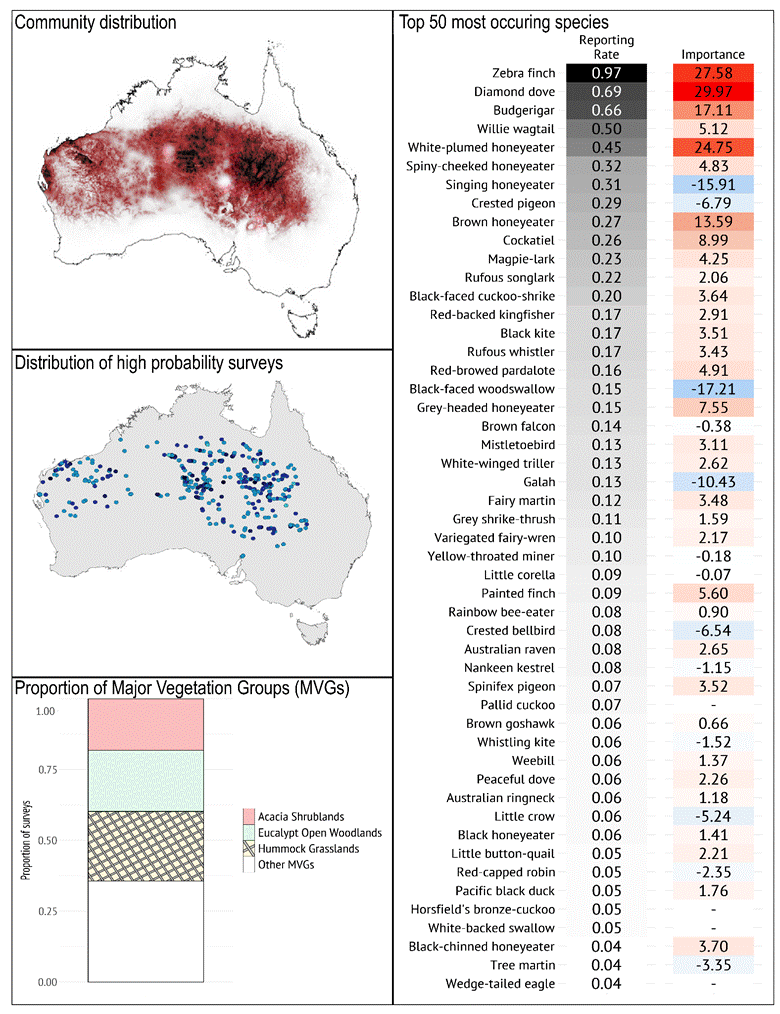
The distribution of the General Arid Zone bird community is generally similar to that of the Arid Open Grassland with Sparse Trees bird community, but a little more restricted and somewhat further north. It ranges in a band from Eighty Mile Beach (WA) and Kalbarri (WA) in the west, to Gilberton (QLD) and Bourke (NSW) in the east. The areas with the highest probability of this community occurring in areas with higher water availability including around Tjoritja / West MacDonnell National Park in the Northern Territory (and surrounding ranges), in the north-eastern Lake Eyre Basin of south-west Queensland, and around Mount Sheila (WA) and Kennedy Range (WA). It frequently occurs in hilly arid areas.
Species composition
Typical species: The General Arid Zone bird community is typified by the prevalence of Zebra Finch, Diamond Dove, Budgerigar, Willie Wagtail, and White-plumed Honeyeater. It is best distinguished from other communities in the Arid Zone by the prevalence of Zebra Finch and White-plumed Honeyeater, and the low occurrence of Crimson Chat and Crested Bellbird. Although recorded at low frequencies, the arid-zone, rocky range specialists such as Spinifex Pigeon, Grey-headed Honeyeater and Painted Finch are a distinctive component of this broad community.
Guild structure: The community is dominated by small ground-foraging granivores (e.g. Zebra Finch, Diamond Dove, Budgerigar), with a substantial representation of nectarivores (e.g. White-plumed, Spiny-cheeked, Singing, and Brown Honeyeaters) and relatively few insectivores relative to other bird communities.
Temporal dynamics: With a high proportion of nomadic species in this community, temporal dynamics are likely linked to availability of resources across multi-season time spans. Many of the granivores breed opportunistically (e.g. Budgerigar, Painted Finch, Zebra Finch) and can be eruptive breeders when conditions are favourable (Jordan et al. 2017).
Geographical variation: Most species in this community occur throughout its extent, but the Spotted Bowerbird found in Queensland portions of the Lake Eyre Basin is replaced by the Western Bowerbird in central and Western Australia, while different subspecies of Spinifex Pigeon occur from east to west.
Vegetation/habitat associations
The General Arid Zone bird community occurs primarily in (Spinifex-dominated) hummock grasslands, Eucalypt open woodlands, and Acacia shrublands Major Vegetation Groups (MVGs). Understory in these vegetation types is likely to have a high prevalence of perennial and annual grasses that provide seed for foraging. Dominant trees are likely to provide seasonal flowering resources, and understory probably lacks a diversity of shrubs and flowering species that would provide habitat for insects and insect-foraging birds.
Inland Nomads
Geographical occurrence
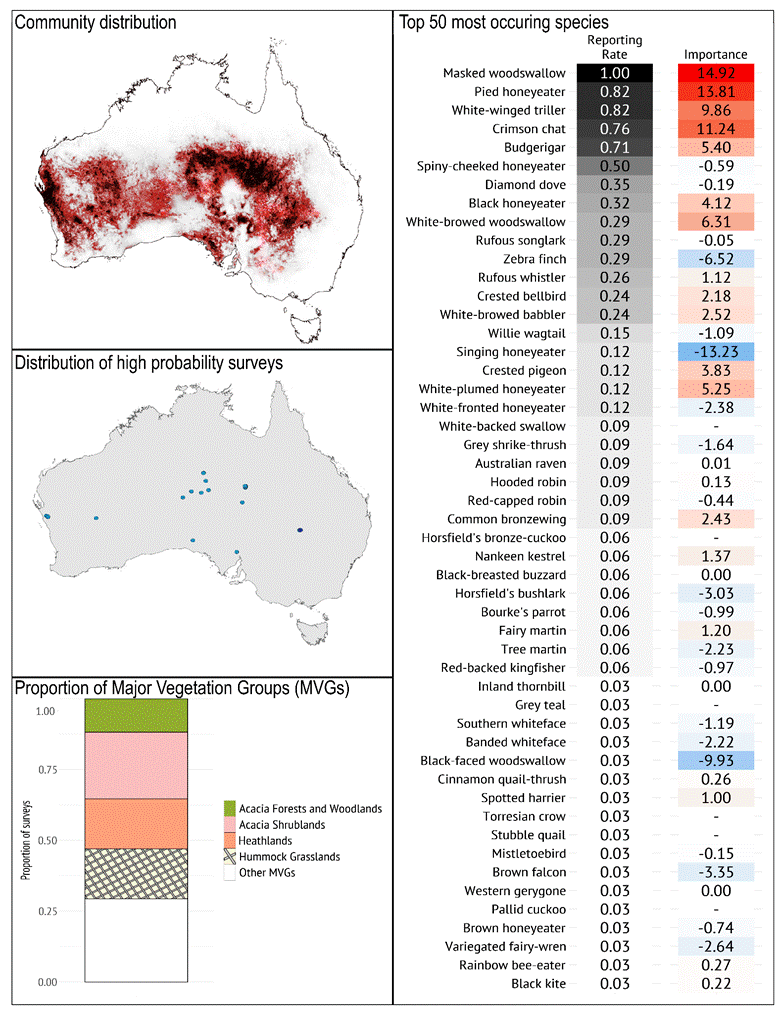
The Inland Nomads bird community has spatially – and likely, temporally – patchy occurrence across arid regions of western, central and southern Australia. It ranges from Exmouth to Williams in Western Australia, skirting the top of the Nullarbor Plain and around the Simpson Desert to reach as far east as Bourke (NSW).
Species composition
Typical species: The Inland Nomads bird community is almost always associated with Masked (and often White-browed) Woodswallow, and includes several nomadic and/or irruptive species such as Pied Honeyeater, White-winged Triller, Crimson Chat, and Budgerigar. It is best distinguished from other communities in the Arid Zone region by the high prevalence of Masked Woodswallow, Pied Honeyeater, and White-winged Triller
Guild structure: This community includes many small- and medium-sized nectarivores, as well as small granivores and aerial and ground-foraging insectivores.
Temporal dynamics: This is a highly variable community, and its distribution is likely to change substantially by season and also in response to resource pulses caused by rainfall events.The most common species in this community are migratory (e.g. Masked Woodswallow, White-winged Triller, White-browed Woodswallow, Rufous Songlark) or nomadic and irruptive Budgerigar, Black Honeyeater, Crimson Chat, Diamond Dove, Pied Honeyeater).
Geographical variation: The wide-ranging nomads of inland Australia are characterised by their lack of geographical variation, although the complex, recent evolutionary divergence of White-browed and Masked Woodswallows (Joseph 2017) has its origins in west vs east centres of occurrence.
Vegetation/habitat associations The Inland Nomad bird community occurs primarily in Acacia shrublands, heathlands, hummock grasslands Major Vegetation Groups (MVGs).

