The Northern Australia region consists of five bird communities: Eastern Tropical Forest and Monsoon Thicket, Eastern Tropical and Subtropical Woodland, Northern Tropical Forest and Monsoon Thicket, Northern Savanna, and Tiwi Islands and Cape York. Eucalypt woodlands and open forests dominate this region, with patches of Acacia, Melalauca and Casuarina Major Vegetation Groups (MVGs) throughout. The Eastern and Northern Tropical Forest and Monsoon Thicket bird communities differ from the others in that they occur in rainforests and vine thickets. The vast majority of the Tiwi Islands and Cape York bird community comprises a single MVG, Eucalypt open forests, while the other bird communities are spread more evenly across multiple MVGs.
Northern Australia is characterised by highly seasonal rainfall patterns, whereby rain predominantly falls between November and April (wet season), while the months of May to October receive little or no rain (dry season). There are rainfall gradients apparent across the five sub-communities and broad habitat types across the region, with the greatest rainfall occurring in coastal areas and rainfall declining north to south (Spessa et al. 2005; Hutley et al. 2011). Average annual rainfall totals range from >2000 mm in coastal areas (e.g. areas occupied by the Tiwi Island and Cape York bird community) to <600 mm in the more xeric, southern parts, inhabited by the Northern Savanna bird community, in which interannual rainfall can vary greatly.
Fire plays a major role in maintaining vegetation patterns across the region, with fire most frequent in open savannas, somewhat less frequent in other dry regions and very infrequent in vine thicket areas (Spessa et al. 2005). Though often characterised as a singular intact community (e.g., northern Australian tropical savannas) there is remarkable variation in topography, land use and land types, which is more apparent in Queensland, compared to the more uniform Top End savannas. In general, differences in the structural complexity, dominant tree species and amount of canopy cover present across Northern Australia influence the bird community assemblages found in each. What is often overlooked is the presence of Noisy Miners in many of the east coastal and upland savanna communities in Queensland, which gives way to Yellow-throated Miners across much of the remainder of northern Australia (Eyre et al. 2009; Mac Nally et al. 2014; Kutt et al. 2016). This, coupled with more intensive land use in Queensland, has had a transformative effect on some bird communities (Hernandez et al. 2024). The patterns of birds in this region and then each community, though in some respects fairly uniform, reflect this subtle variation, and the typical determinants of bird occurrence and composition. For example, in open savannas with lower rainfall there are more generalists (e.g., Peaceful Dove, Willie Wagtail, Magpie-lark), while where there is more structurally complex vegetation with higher canopy cover on the east coast, more perching and gleaning species are apparent (e.g., Little Shrike-thrush, Varied Triller).
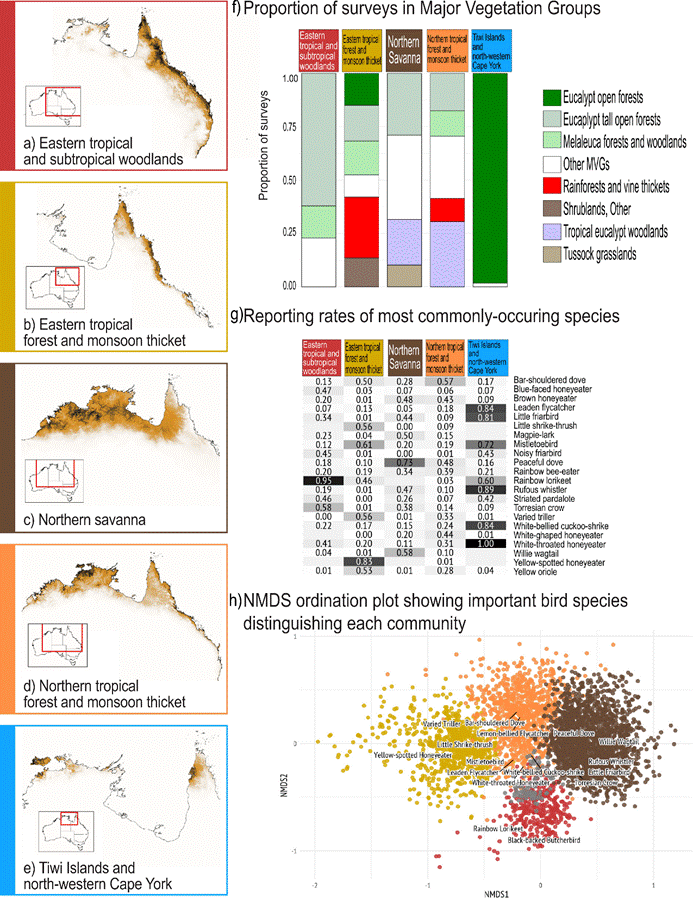
Figure Northern Region: a) to e): Inset maps show location of region, larger maps show modelled distribution of communities based on Maxent models, with darker shading representing a higher likelihood of occurrence. f) proportion of surveys in each community occurring in Major Vegetation Groups (MVGs; MVGs in which >10% of surveys were located shown). g) reporting rates (RR) of the top 5 most commonly occurring species in each community. h) Non-metric multidimensional scaling (NMDS) ordination plot depicting the location in multidimensional space of key species that distinguish communities in this region.
Eastern Tropical Forest and Monsoon Thicket
Geographical occurrence
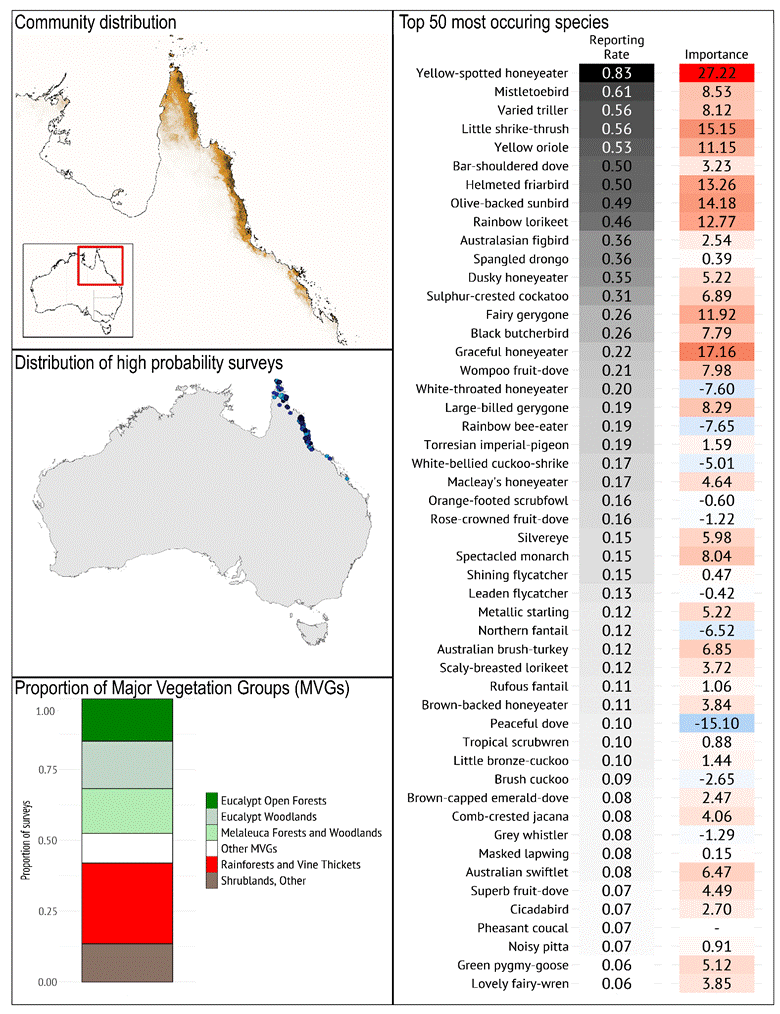
The Eastern Tropical Forest and Monsoon Thicket bird community occurs on the Cape York Peninsula across the northern third of the peninsula north of Coen and then running down the east coast to Clairview. The extent covers numerous national parks including Girringun, Wooroonooran, Gadgarra, Malbon Mount Lewis, Daintree, and Jardine River.
Species composition
Typical species: It is typified by the high prevalence of Yellow-spotted Honeyeater, Mistletoebird, Varied Triller, Little Shrike-thrush, and Yellow Oriole. The Eastern Tropical Forest and Monsoon Thicket bird community is best distinguished from the other communities in the region by the prevalence of Yellow-spotted, Graceful Honeyeater, Olive-backed Sunbird and Little Shrike-thrush (which distinguishes it from the Northern Tropical Forest and Monsoon Thicket community largely as these species do not occur in the Northern Territory), Yellow Oriole, and Varied Triller. Notably, it also has lower reporting rates than other communities in this region for Brown Honeyeater, Little Friarbird, Magpie Lark, Rufous Whistler, Striated Pardalote, Torresian Crow, White-gaped Honeyeater and Willie Wagtail, as these are species that occur across the rainfall gradient.
Guild structure: As this community occurs predominantly in rainforest and vine thicket MVGs, the Eastern Tropical Forest and Monsoon Thicket bird community is characterised by relatively high reporting rates of frugivores (e.g., Yellow Oriole, Mistletoebird) and nectarivores (e.g., Yellow-spotted Honeyeater, Olive-backed Sunbird, fruit pigeons).
Temporal dynamics: A relatively temporally stable community but augmented by summer breeding migrants such as Metallic Starling.
Geographical variation: Most species that typify this community occur throughout its range but some are more likely to occur in denser or more coastal locations, e.g., Black Butcherbird, Large-billed Gerygone.
Vegetation/habitat associations
The Eastern Tropical Forest and Monsoon Thicket bird community occurs near this coast, most commonly in rainforests and vine thickets, but also in Eucalypt woodlands, Melaleuca forests and woodlands, and Eucalypt open forests Major Vegetation Groups (MVGs).
Eastern Tropical and Subtropical Woodland
Geographical occurrence
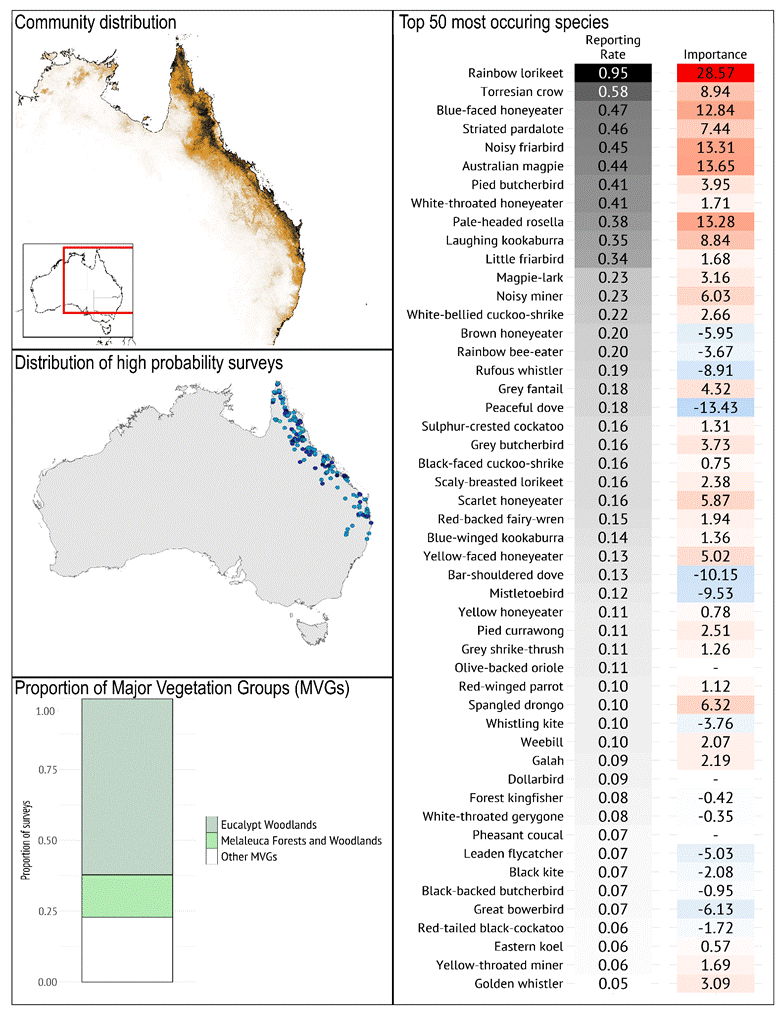
The Eastern Tropical and Subtropical Woodland bird community extends further inland than does the Eastern Tropical Forest and Monsoon Thicket community, including on the inland slopes of the Great Dividing Range, throughout the tropical and subtropical zones. The northern-most occurrences of the community include the drier woodlands of Cape York Peninsula, and south to approximately central New South Wales. Its modelled distribution occurs as far west as Katherine in the Northern Territory.
Species composition
Typical species: Eastern Tropical and Subtropical Woodland is typified by the prevalence of Rainbow Lorikeet, Torresian Crow, Blue-faced Honeyeater, Striated Pardalote, and Noisy Friarbird. The community is best distinguished from other communities in the region by the high reporting rate of Rainbow Lorikeet (rather than Red-Collared Lorikeet), Torresian Crow, and Blue-faced Honeyeater, Australian Magpie and Pale-headed Rosella, and is less likely to include Yellow-spotted and Yellow-tinted Honeyeater, Olive-backed Sunbird, and Yellow Oriole.
Guild structure: The community is dominated by larger-bodied insectivores/carnivores and nectarivores, with relatively few granivores, frugivores and smaller-bodied insectivores. Aggressive and territorial Noisy or Yellow-throated Miners can dominate, which may reflect why the dominant birds are large-bodied rather than small-bodied. The dominance of Noisy Miners (in the south of this community) and Yellow-throated Miners (in the north and west of this community is exacerbated by broadscale clearing of habitat and increased timber harvesting activity (Eyre et al. 2009; Mac Nally et al. 2014; Kutt et al. 2016).
Temporal dynamics: Many of the honeyeaters, including friarbirds and smaller species, are migrants/nomads, contributing to the seasonal variation in this community. They will also occur in the structurally more complex components of this community.
Geographical variation: Some species only occur toward the northern part of the community’s extent, such as Yellow Honeyeater, Blue-winged Kookaburra and Great Bowerbird.
Vegetation/habitat associations
The Eastern Tropical and Subtropical Woodland bird community occurs primarily in Eucalypt woodlands and Melaleuca forests and woodlands Major Vegetation Groups (MVGs).
Northern Tropical Forest and Monsoon Thicket
Geographical occurrence
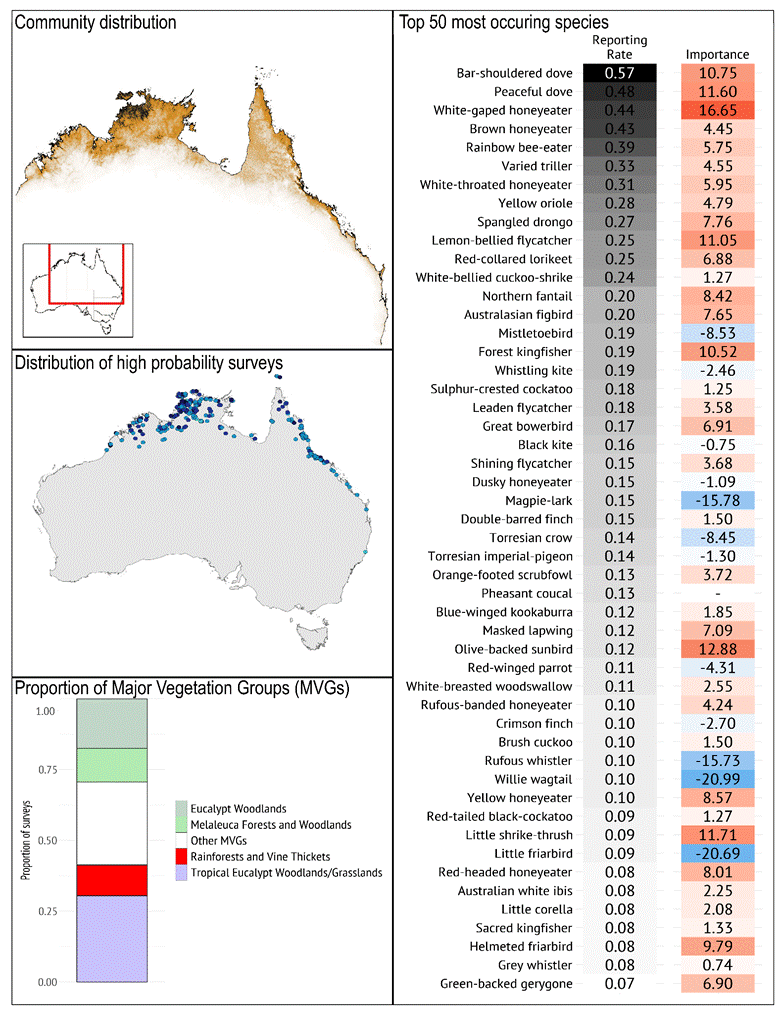
The Northern Tropical Forest and Monsoon Thicket bird community occurs from Broome in Western Australia, across the top of the Northern Territory across to Cape York Peninsula, with the likelihood of occurrence tailing off down the east coast of Queensland towards Maryborough; the Queensland part of its distribution may stem from its similarity with Eastern Tropical Forest and Monsoon Thicket, but several key species distinguish the two. The highest probability of occurrence is around the Tiwi Islands, Kakadu, and Darwin in the Northern Territory.
Species composition
Typical species: The Northern Tropical Forest and Monsoon Thicket bird community is typified by the prevalence of Bar-shouldered Dove, Peaceful Dove, White-gaped Honeyeater, Brown Honeyeater, and Rainbow Bee-eater, species that occur across the entire distribution of the community. The community has intermediate reporting rates of many of the species common to the region. It is best distinguished from other communities based on the higher reporting rate of Forest Kingfisher, White-gaped Honeyeater, Olive-backed Sunbird, Little Shrike-thrush, and Lemon-bellied Flycatcher.
Guild structure: Granivorous doves are common in the Northern Tropical Forest and Monsoon Thicket bird community (e.g. Bar-shouldered, Peaceful Dove), frugivores are also well represented (e.g. Yellow Oriole, Australisian Figbird), the rest of the community comprises a mix of insectivores, carnivores, and honeyeaters of different sizes.
Temporal dynamics: Most of the species in this community are resident, but as with most of the Northern Australian communities, the rainfall seasonality, coupled with fire history and the high number of honeyeaters, means that the relative abundance of each species will reflect the resources present at a site. Species such as the Rainbow Bee-eater seasonally migrate.
Geographical variation: The commonest parrot in this community is the Red-collared Lorikeet, replaced by the Rainbow Lorikeet in the east; Yellow Honeyeater and Olive-backed Sunbird occurs only in the east while Green-backed Gerygone occurs only in the Top End and Kimberley. Most other typical species occur throughout the community’s extent. Little Shrike-thrush have now been split into Arafura (west) and Rufous (east).
Vegetation/habitat associations
The Northern Tropical and Subtropical Woodland bird community occurs primarily in tropical Eucalypt woodlands/grasslands, and Eucalypt woodlands Major Vegetation Groups (MVGs).
Northern Savanna
Geographical occurrence
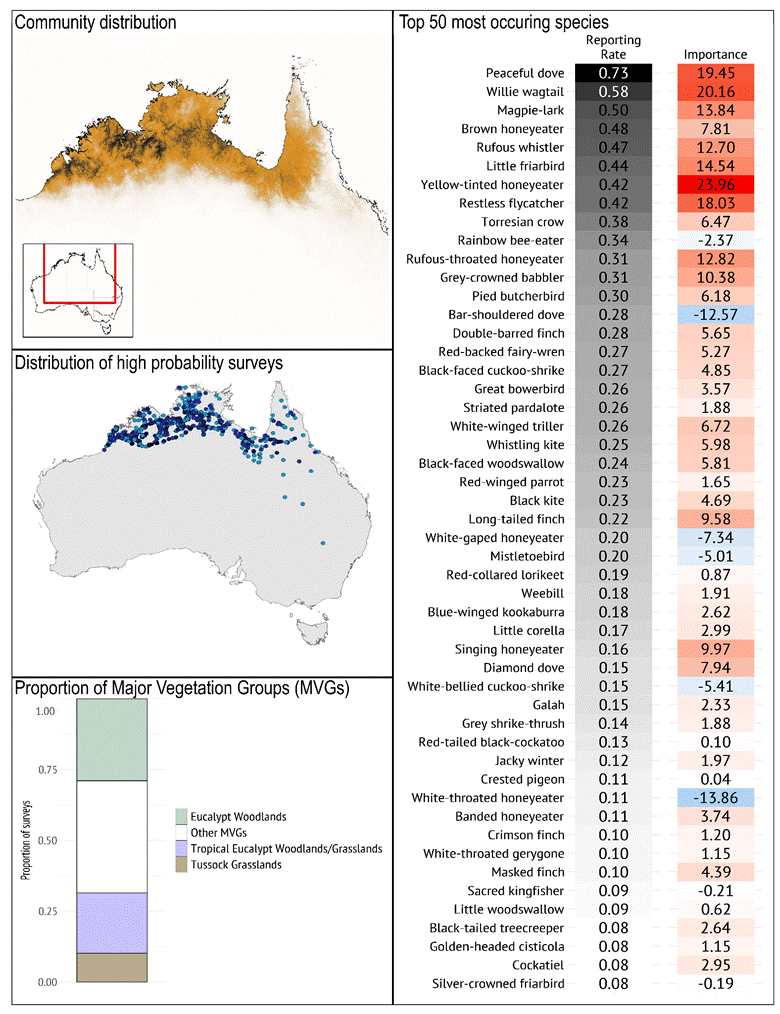
The Northern Savanna bird community occurs throughout the northern savanna woodland zone across northern Australia; from Eighty Mile Beach in Western Australia to the Einasleigh Uplands in Queensland, extending north to the coast and into the Cape York Peninsula. The highest likelihood of occurrence is in the Wunaamin Miliwundi Ranges and the ranges around Lake Argyle in Western Australia.
Species composition
Typical species: The Northern Savanna bird community is typified by the prevalence of Peaceful Dove, Willie Wagtail, Magpie-lark, Brown Honeyeater, and Rufous Whistler. It is best distinguished from the other communities in the region by the higher prevalence of Yellow-tinted Honeyeater, Magpie-lark, Restless Flycatcher, and Willie Wagtail, and the lower reporting rate of Yellow Oriole, Varied Triller, Spangled Drongo, and Lemon-bellied Flycatcher.
Guild structure: The Northern Savanna bird community is dominated by species that prefer more open woodlands. This includes both small and large granivores (e.g. Peaceful Dove, Bar-shouldered Dove, Double-barred and Long-tailed Finch, Red-winged Parrot), as well as insectivores that typically forage on the ground, or from low perches (e.g. Willie Wagtail, Magpie-lark, Restless Flycatcher, Grey-crowned Babbler). There are also birds of prey (e.g. Whistling Kite, Black Kite), and a mix of resource-tracking nectarivores (Brown, Yellow-tinted, and Rufous-throated Honeyeater and Little Friarbird).
Temporal dynamics: The presence of honeyeaters is driven by flowering of nectar-bearing plants, and granivore dynamics are affected by fire which is a common disturbance in this community.
Geographical variation: As this community spans a large extent there are some species which only enter this community in the east such as Brown Treecreeper and Black-throated Finch which are replaced in the north and west by Black-tailed Treecreeper and Long-tailed Finch; others only occur on the inland fringes (e.g. Grey-fronted Honeyeater).
Vegetation/habitat associations
The Northern Savanna bird community occurs primarily in Eucalypt woodlands, and tropical Eucalypt woodlands/grasslands Major Vegetation Groups (MVGs).
Tiwi Islands and Cape York

Geographical occurrence
The unusual distribution of the Tiwi Islands and Cape York bird community occurs in the Tiwi Islands and the north west portion of the Cape York Peninsula, as well as just south of the Tiwi Islands on the Cox Peninsula.
Species composition
Typical species: The Tiwi Islands and Cape York bird community is typified by the prevalence of White-throated Honeyeater, Rufous Whistler, White-bellied Cuckoo-shrike, Leaden Flycatcher, and Little Friarbird. It is best distinguished from other communities in the region by the high reporting rate of White-throated Honeyeater, White-bellied Cuckoo Shrike, Rufous Whistler, Little Friarbird and Leaden Flycatcher, typical of tall open forest vegetation. Also important in distinguishing the community is the virtual absence of Little Shrike-thrush, Magpie-lark, Noisy Friarbird, Varied Triller, White-gaped Honeyeater, Willie Wagtail, and Yellow-spotted Honeyeater.
Guild structure: Typical of the Northern Australia region, granivores are strongly represented (e.g. Peaceful Dove, Bar-shouldered Dove) in the Tiwi Islands and Cape York bird community. It is a distinctly open-forest community with a dominance of large predatory species (e.g. Laughing Kookaburra (Cape York only), Blue-winged Kookaburra, Pied Butcherbird, Black-backed Butcherbird (Cape York only), and flycatchers (e.g. Leaden Flycatcher, Lemon-bellied Flycatcher, Northern Fantail) along with a mix of nectarivores and insectivores.
Temporal dynamics: The species that distinguish this community are typically resident, with a standard mix of honeyeaters and granivores that will track resources within the region depending on season, flowering and land management.
Geographical variation: The main variation in this community is between its occurrence on the Tiwi Islands and that on western Cape York Peninsula, resulting in species substitutions like Red-collared/Rainbow Lorikeet and Northern/Pale-headed Rosella, and some species like Laughing Kookaburra, Black-backed Butcherbird, Yellow Honeyeater and Noisy Friarbird occurring only in the east.
Vegetation/habitat associations
The vast majority of the Tiwi Islands and Cape York bird community occurs in the Eucalypt open forests Major Vegetation Group (MVG).

