The South-eastern woodland region consists of four communities, Eastern Heathy Woodland, three South-eastern Woodland communities (Coastal and Mid-elevation, Cool Temperate Lowland, Dry Lowland). The climate envelope of the three different South-eastern Woodlands communities differs by elevation, rainfall and temperature, they are similar in species composition and also in the break-down of occurrence in different Major Vegetation Groups (MVGs). The Eastern Heathy Woodland bird community had lower prevalence in the Eucalypt open and tall open forests MVGs than the three South-eastern Woodland communities in this region, and correspondingly higher prevalence in Eucalypt open woodland, heathlands, and ‘other shrublands’ MVGs. All of the communities in this region had high prevalence in Eucalypt woodlands. The composition of the bird communities comprising this region and Region A2 (eastern wet forests and coastal heath) includes a group of migratory species (e.g. Yellow-faced Honeyeater, White-naped Honeyeater, Fan-tailed Cuckoo, Grey Fantail) that fly south along the eastern coastal regions to breed in the spring and then north to escape the southern winter. These species become an important seasonal (spring-summer) component of the region.
Landscape-scale fires can remove key resources needed by the communities making up the South-eastern Woodlands region. Some species (e.g. White-throated Treecreeper, Golden Whistler) may be reliant upon unburnt refuges in adjacent more mesic MGVs (e.g. Open Tall Forests, Rainforests) during the decades following a fire, from which these species will eventually recolonise the less mesic, burnt woodland habitats as they recover (Robinson et al. 2014, 2016).
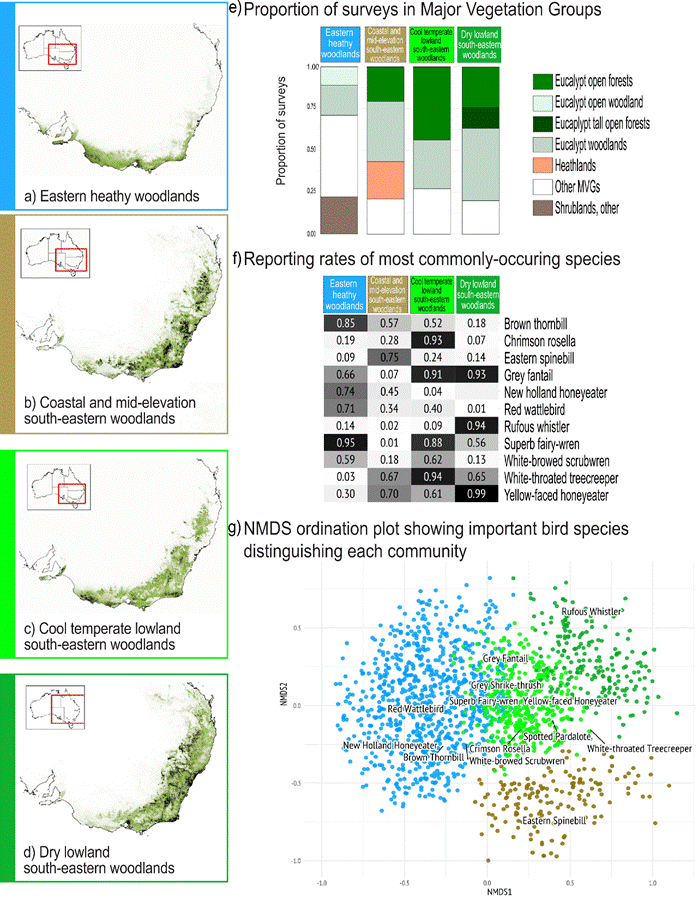
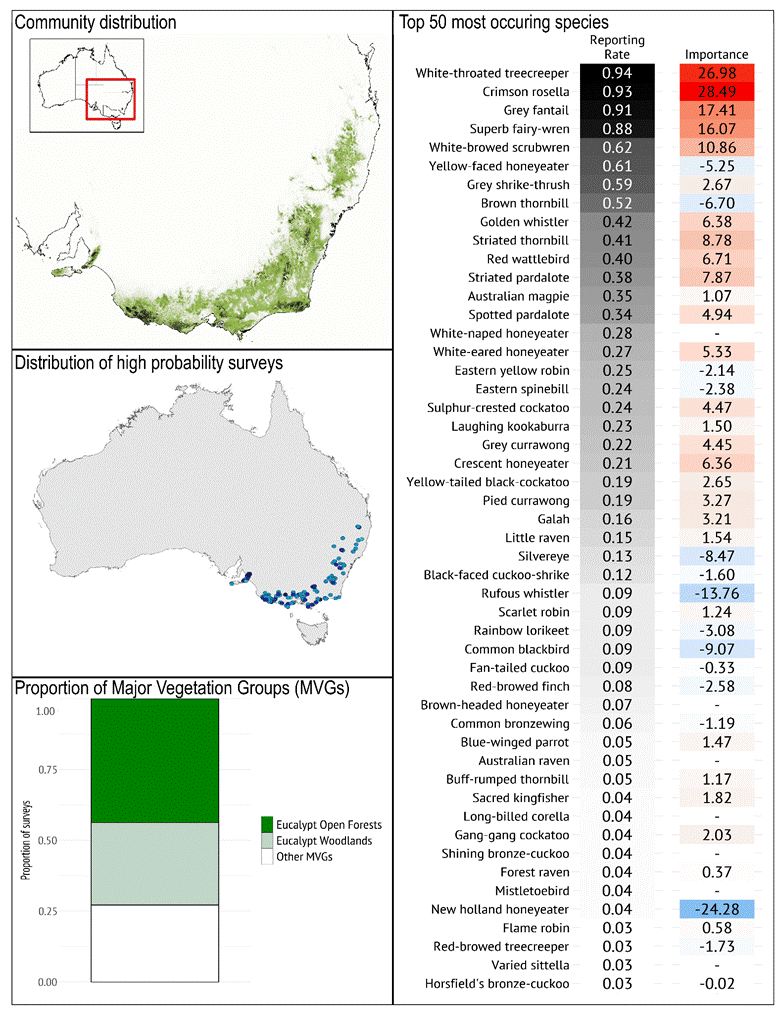
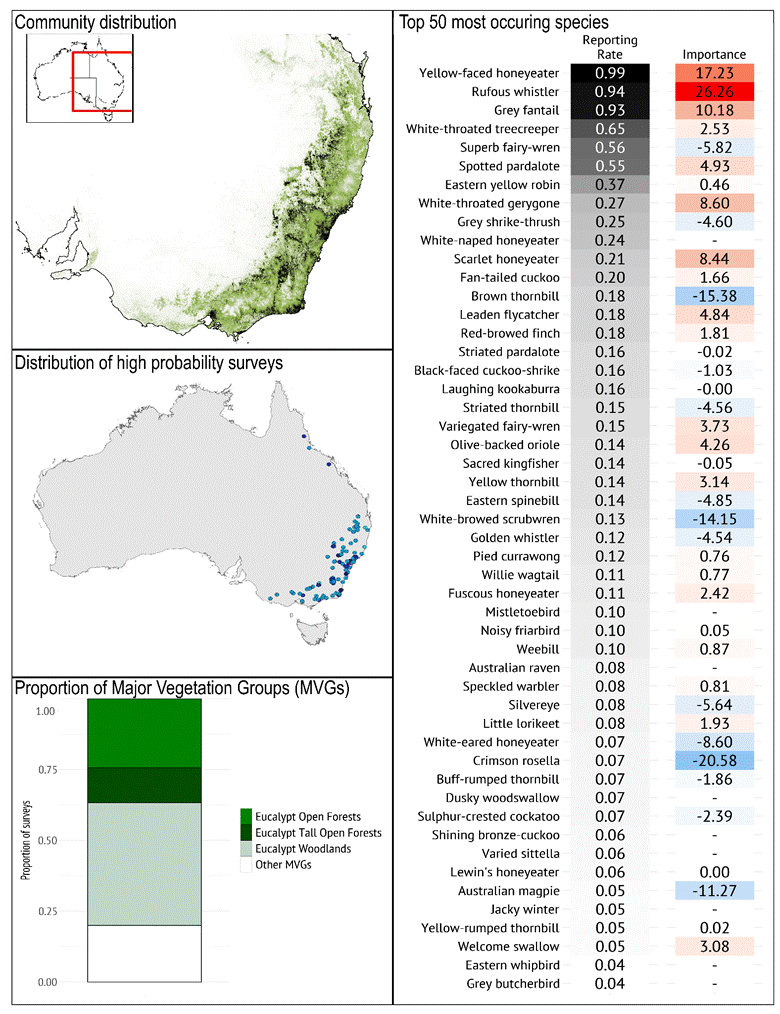
Figure Region A3: a) to d): Inset maps show location of region, larger maps show modelled distribution of communities based on Maxent models, with darker shading representing a higher likelihood of occurrence. e) proportion of surveys in each community occurring in Major Vegetation Groups (MVGs; MVGs in which >10% of surveys were located shown). f) reporting rates (RR) of the top 5 most commonly occurring species in each community. g) Non-metric multidimensional scaling (NMDS) ordination plot depicting the location in multidimensional space of key species that distinguish communities in this region.
Eastern Heathy Woodland
Geographical occurrence
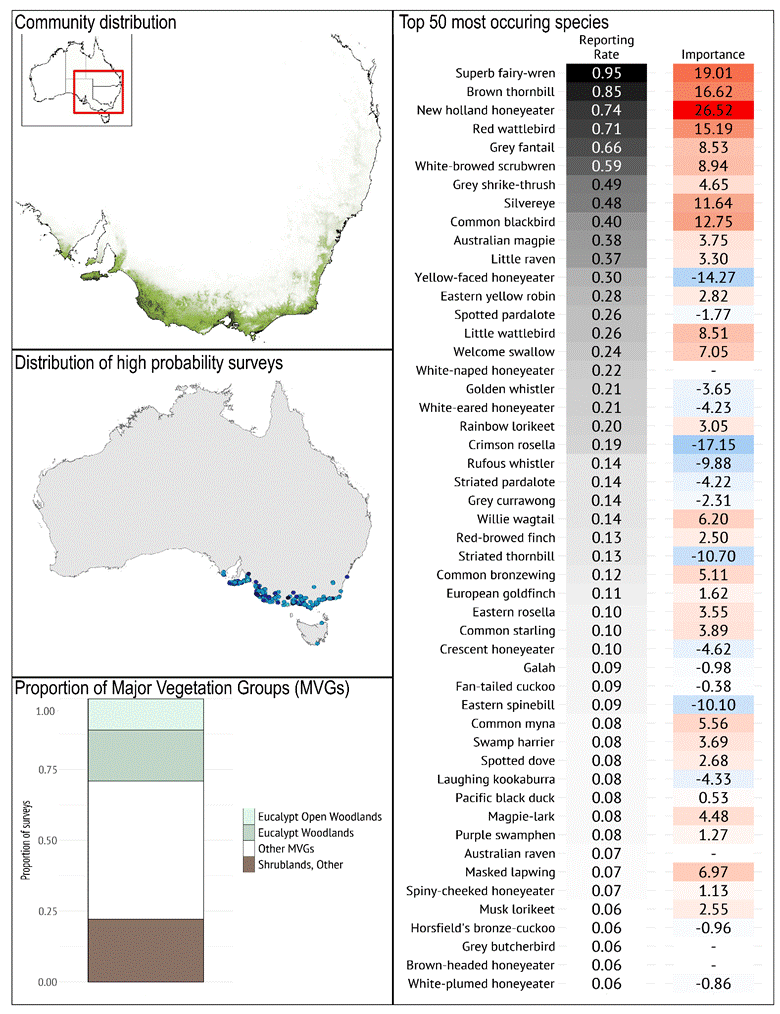
The Eastern Heathy Woodland bird community occurs in heathlands and heathy forests and woodlands in cool areas (with annual temperatures near 15-16 degrees) along the south east fringe of Australia. The community runs from the Eyre peninsula, around the bottom of Victoria and up the east coast into New South Wales.
Species composition
Typical species: It is typified by the prevalence of Superb Fairy-wren, Brown Thornbill, New Holland Honeyeater, Red Wattlebird and Grey Fantail. It distinguishes itself from other communities in this region based on the higher likelihood of Brown Thornbill, New Holland Honeyeater, Red Wattlebird, Superb Fairy-wren occurring. The White-browed Scrubwren is also more likely to occur in this community, though also in the Cool Temperate Lowland South-eastern Woodland bird community. Equally important in distinguishing the community is the low likelihood of White-throated Treecreeper and Weebill occurring.
Guild structure: The community is distinguished from the other communities in this region by the abundance of the nectarivores Red Wattlebird and New Holland Honeyeater, and by the prevance of small understorey-dependent insectivores, nsectivores that forage at a range of heights and substrates but especially in the shrub layer.
Temporal dynamics: Eastern heathy woodlands experience significant fires, after which the Eucalypts and grass trees resprout, triggering mass flowering events (e.g. of Xanthorrhoea spp.) that attract a suite of nectarivore species, often at high abundance (Rainsford et al. 2022).
Geographic variation: Most species that typify this community occur throughout its extent, though with local variation e.g. Crescent Honeyeaters tend to occur in more mesic examples of this community type.
Vegetation/habitat associations
The Eastern Coastal Woodland bird community is most prevalent in the ‘other shrublands’ and Eucalypt woodlands Major Vegetation Groups (MVGs). Eastern Heathy Woodland communities overlap in bird species composition with other woodland communities depending upon the level of cover provided by emergent trees (e.g. Eucalypts or Allocasuarinas); increasing the likelihood of species associated with trees being present (e.g. Rufous Whistler, White-troated Treecreeper), and diminishing likelihood of species more associated with treeless heaths (e.g. Striated Fieldwren, Southern Emu-wren).
Coastal and Mid-elevation South-eastern Woodland
Geographical occurrence
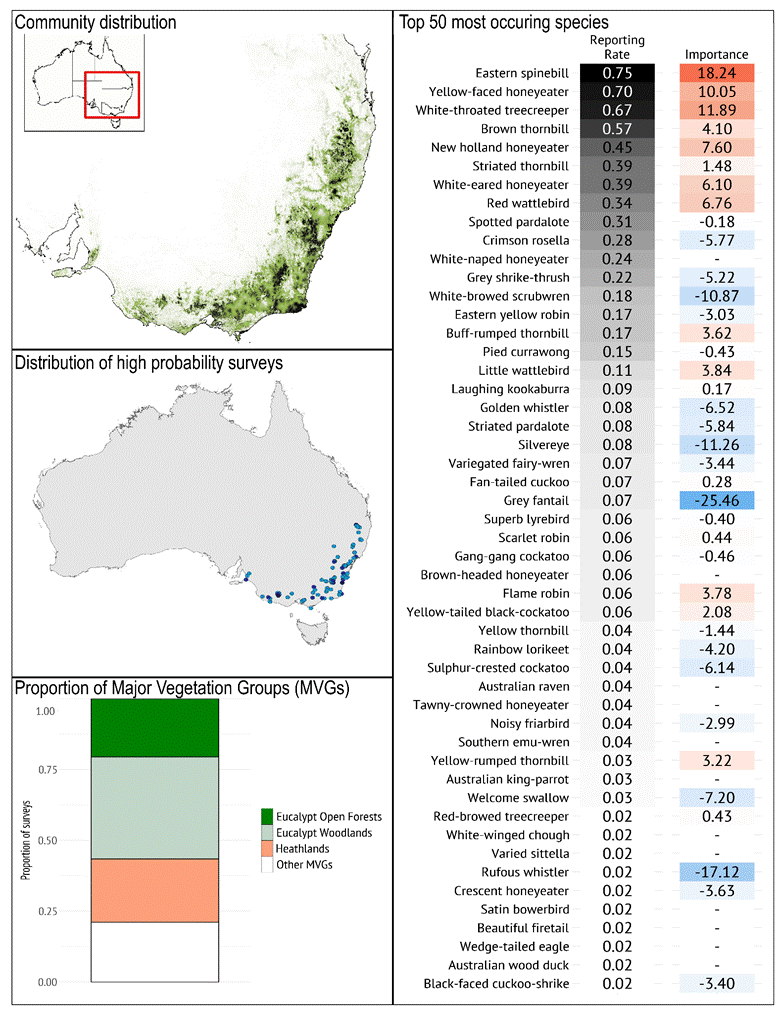
The South-eastern Woodland 1 bird community occurs in the woodlands of south-eastern Australia, primarily associated with the ridges and peaks (though not alpine or subalpine areas) along the great dividing range, occurring in areas which have higher rainfall than the other communities in this region. It stretches from Kangaroo island and Flinders Ranges in South Australia, across through the Grampians, Kara Kara, Lerderderg parks and across Victoria’s inland slopes before joining the main extent of the great dividing range and continuing up to the northern New England Tableland bioregion.
Species composition
Typical species: The Coastal and Mid-Elevation South-eastern Woodland bird community is typified by the prevalence of Eastern Spinebill, Yellow-faced Honeyeater, White-throated Treecreeper, Brown Thornbill, and New Holland Honeyeater. The community is distinguished from the other south-eastern woodland communities by the high likelihood of finding Eastern Spinebill and lower likelihood of finding Grey Fantail, Rufous Whistler, and Superb Fairy-wren. This community contains more of the typical wetter forest species like spinebills and brown thornbills than the other communities in this region.
Guild structure: The community is dominated by small to medium insectivores and nectarivores of all sizes. Lower in reporting rate but still important are forest cockatoos (Gang-gang Cockatoo and Yellow-tailed Black-Cockatoos, with the latter often occurring near pine plantations which they exploit as a food source, or in heathy woodland where they take woody seeds of native plants such as Hakea and Banksia spp.).
Temporal dynamics: The community is characterised by high seasonal turnover, with approximately 50% of breeding residents absent during the winter (Recher et al. 1983). Reporting rates of nectarivores (Eastern Spinebill, New Holland Honeyeater, Red Wattlebird, Yellow-faced Honeyeater) also vary substantially as they track floral resources.
Geographical variation: Most species typical of this community occur throughout its extent. Exceptions include Variegated Fairy-wren (absent from southern parts), Little Wattlebird (confined to heathy woodland, especially near coast) and New Holland Honeyeater (very common in gardens and heathy woodland, but scarce in forests elsewhere).
Vegetation/habitat associations
The South-eastern Woodland 1 bird community is most prevalent in eucalypt woodlands with sparse mixed proteaceous understory, heathlands and eucalypt open forests Major Vegetation Groups (MVGs).
Cool Temperate Lowland South-eastern Woodland
Geographical occurrence
The Cool Temperate Lowland South-eastern Woodland bird community occurs in more fertile low lying hills, in cooler areas of south-eastern Australia. The western extent of the community is in the Flinders Ranges and Kangaroo Island, then there is a gap in the distribution which resumes in the Naracoorte area before sweeping in a thick band around south-eastern Australia, through the Strzelecki Ranges (Radford & Bennett 2005), east Gippsland, eastern slopes of the Great Dividing Range, and as far north as Brisbane.
Species composition
Typical species: The Cool Temperate Lowland South-eastern Woodland bird community is typified by the prevalence of White-throated Treecreeper, Crimson Rosella, Grey Fantail, Superb Fairy-wren, and White-browed Scrubwren. The community is best distinguished from the other communities in this region by the prevalence of White-throated Treecreeper and Crimson Rosella, and the low probability of finding the New Holland Honeyeater or Rufous Whistler.
Guild structure: The community is dominated by small and medium insectivores, including both pardalotes which tend to be associated with Symphomyrtus eucalypts (Woinarski 1985 p. 19). The community also includes many hollow-nesting species, with a substantive representation of mesopredators such as Australian Magpies, Laughing Kookaburra, currawongs and corvids.
Temporal dynamics: The Cool Temperate Lowland South-eastern Woodland community is dominated by a suite of largely sedentary species, presumably as a function of relatively consistent availability of arthropod food resources. It supports a smaller number of local blossom nomads than Coastal and Mid-elevation South-eastern Woodland.
Geographical variation: The species of mesopredators typifying the community, varies across its range with Little, Australian or Forest Raven occurring and Pied and Grey Currawong occurring depending on location.
Vegetation/habitat associations
The Cool Temperate Lowland South-eastern Woodland bird community is most prevalent in Eucalypt open forests and Eucalypt woodlands Major Vegetation Groups (MVGs). Some of the small insectivores are tied to the presence of some understory particularly along gullies and drainage lines (scrubwrens, thornbills, yellow robins, fairy-wrens). The presence of sufficient tree cover of varying ages would support the treecreepers and rosellas. This community is also representative of woodlands with a sparse understory and where there might be some bigger trees.
Dry Lowland, South-eastern Woodland
Geographical occurrence
The Dry Lowland South-eastern Woodland bird community is most likely to occur in warmer and drier, low lying areas than the other south-eastern woodland bird communities. There is a slight chance of this community occurring as far to the west as the Flinders Ranges but the areas with the highest probability of occurrence are south-east suburbs of Melbourne, Gippsland Plains, the Nooramunga Marine and Coastal Park, the ACT, Croajingalong National Park, greater Sydney area, and NSW central tablelands. The composition of this community is similar to that of the South-eastern Open Box-Gum Woodland bird community, the primary differences being in the difference in occupancy of Grey Fantails and Rufous Whistler which are much more prevalent in the Dry Lowland South-eastern Woodland.
Species composition
Typical species: The Dry Lowland South-eastern Woodland bird community is typified by the prevalence of Yellow-faced Honeyeater, Rufous Whistler, Grey Fantail, White-throated Treecreeper, and Superb Fairy-wren (Radford & Bennett 2005).
Guild structure: The community is dominated by small to medium insectivores, with a relatively low diversity of nectarivores compared with the other south-east woodland communities. Nest parasites were present at higher reporting rates than the other two south-eastern woodland bird communities.
Temporal dynamics: This community is characterised by the abundance of summer migratory species responding to the relatively high seasonal abundance of arthropods. These include Sacred Kingfisher, Olive-backed Oriole, Leaden Flycatcher, White-throated Gerygone and cuckoos. There may also be irruptions of migratory or nomadic nectarivores including Scarlet and Yellow-faced Honeyeater, and typical summer migrants including Sacred Kingfisher, Olive-backed Oriole, and cuckoos.
Geographical variation: The species that typify this community occur throughout its extent.
Vegetation/habitat associations
Like the Cool Temperate Lowland South-eastern Woodland bird community, The Dry Lowland South-eastern Woodland bird community is most prevalent in Eucalypt open forests and Eucalypt woodlands Major Vegetation Groups (MVGs).

