This region consists of three communities, Eastern Coastal Woodland, Eastern Wet Forest, and High Elevation Tropical Rainforest. The NVIS Major Vegetation Groups (MVGs) that these bird communities occur in are much more distinctive than other regions with few overlapping MVGs between communities. Important aspects of the vegetation that are likely to be driving differences in the bird assemblages between communities include the relative proportion of Eucalypts versus non-Eucalypts in the overstorey and the relative dominance and density of the understorey vegetation.
This community comprises a mixture of resident and non-resident nectarivorous and insectivorous birds that show large movement patterns depending on the availability of nectar and insects, that have diverse and complicated patterns of seasonal movements driven by a combination of seasonal flowering patterns of plant species and rainfall events. The plant communities are strongly influenced by fire regimes, and in particular wildfires, which can influence the composition and abundance of the bird community (and movements of birds up and down the coast). The majority of the bird species in these communities are not hollow-dependent, so their distribution is likely driven more by the availability of food resources and environmental gradients.
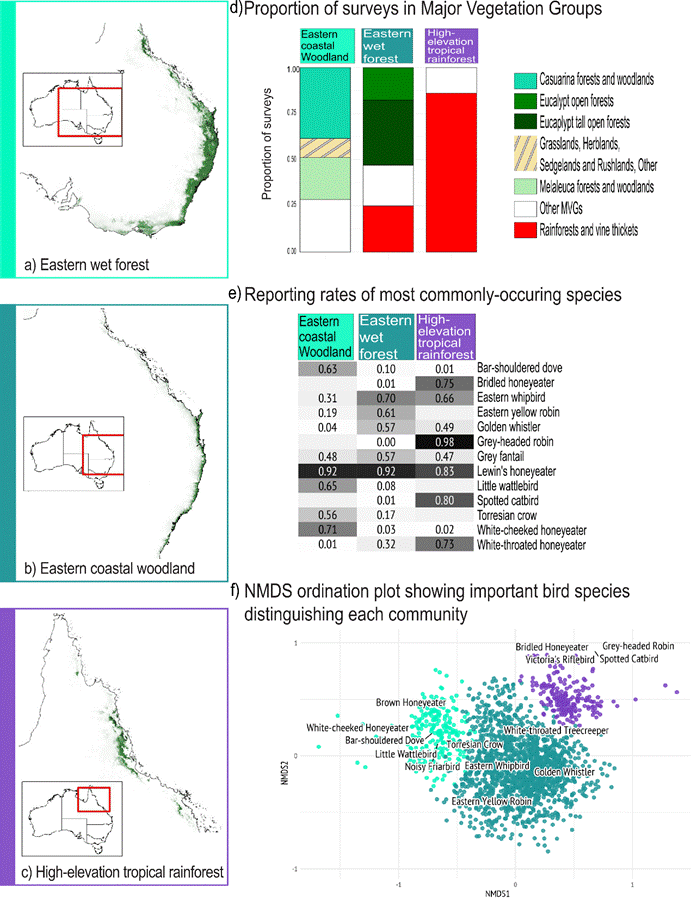
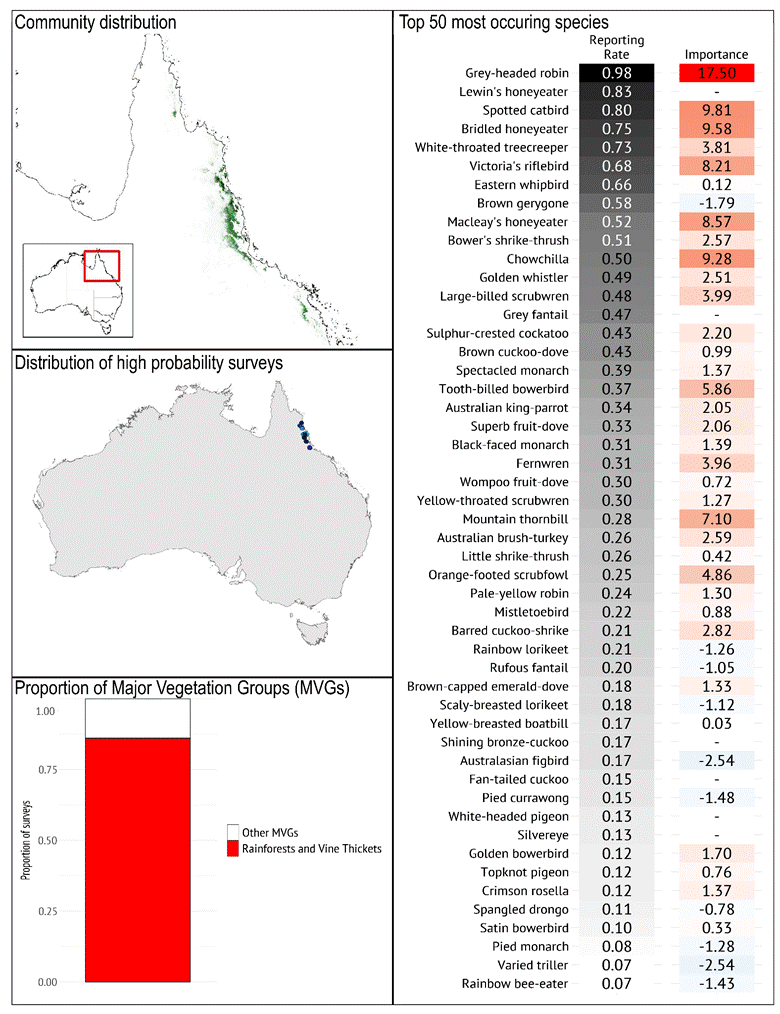
Figure A2 Eastern: a), b) and c): Inset maps show location of region, larger maps show modelled distribution of communities based on Maxent models, with darker shading representing a higher likelihood of occurrence. d) proportion of surveys in each community occurring in Major Vegetation Groups (MVGs; MVGs in which >10% of surveys were located shown). e) reporting rates (RR) of the top 5 most commonly occurring species in each community. f) Non-metric multidimensional scaling (NMDS) ordination plot depicting the location in multidimensional space of key species that distinguish communities in this region.
Eastern Coastal Woodland
Geographical occurrence
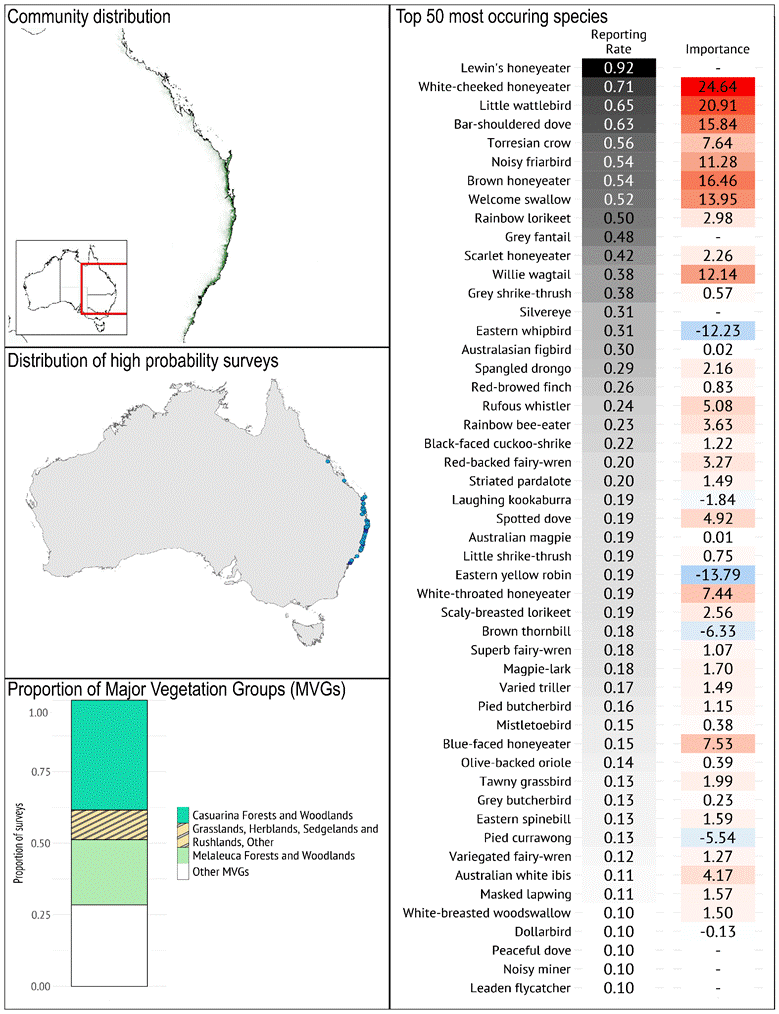
The Eastern Coastal Woodland bird community occurs in a thin strip down Australia’s east coast, mainly in fine-scale mosaics of non-eucalypt dominated coastal woodlands, heath and heathy woodlands, most commonly between southern Queensland to the NSW-Vic border. It shows a species’ richness gradient from north to south, with some species absent in the southern part of the community – for example, Bar-shouldered Dove and Torresian Crow. The distribution of this community coincides strongly with the distribution of Banksia spp along the eastern coast of Australia (especially Banksia integrifolia [Atlas Of Living Australia 2024]).
Species composition
Typical species: The Eastern Coastal Woodland bird community is typified by the prevalence of Lewin’s Honeyeater, White-cheeked Honeyeater, Little Wattlebird, Bar-shouldered Dove and Torresian Crow. The prevalence of the White-cheeked Honeyeater, Little Wattlebird, Brown Honeyeater and Bar-shouldered Dove, and the lower occurrence of the Golden Whistler and White-throated Treecreeper, distinguish it from other communities in this group.
Guild structure: A diversity of honeyeaters, including several medium-sized to large species, dominates this group.
Temporal dynamics: This community is only moderately temporally variable with seasonal and locally nomadic movements by some honeyeaters e.g. Scarlet Honeyeater and relatively low prevalence of summer migrants e.g. Dollarbird.
Geographical variation: Although narrowly distributed close to the coast, this community has a broad north-south distribution, with generally higher species diversity in the north, and a handful of species only occur, or are more common, in northern examples of the community; e.g., Dusky Honeyeater, Bar-shouldered Dove and Torresian Crow.
Vegetation/habitat associations
This community is most prevalent in Casuarina forests and woodlands, and Melaleuca forests and woodlands Major Vegetation Groups (MVGs) with substantial occurrence in Heathlands and Other Forest and Woodlands MVGs. It is much less likely to occur in Eucalypt tall open forests, Eucalypt woodlands, or rainforest and vine thickets which support the other communities in this region. The community occurs in a fine-scale mosaic of different vegetation types, including heathlands and Banksia woodlands. These plant communities typically comprise a diversity of proteaceous plants that provide year-round availability of floral resources (nectar and pollen), including largely pollinator-dependent plant taxa such as Banksia, Persoonia, Hakea, Lambertia, and Grevillea (Armstrong 1979; Cardillo & Pratt 2013; Davis et al. 2014, 2022).
Eastern Wet Forest
Geographical occurrence
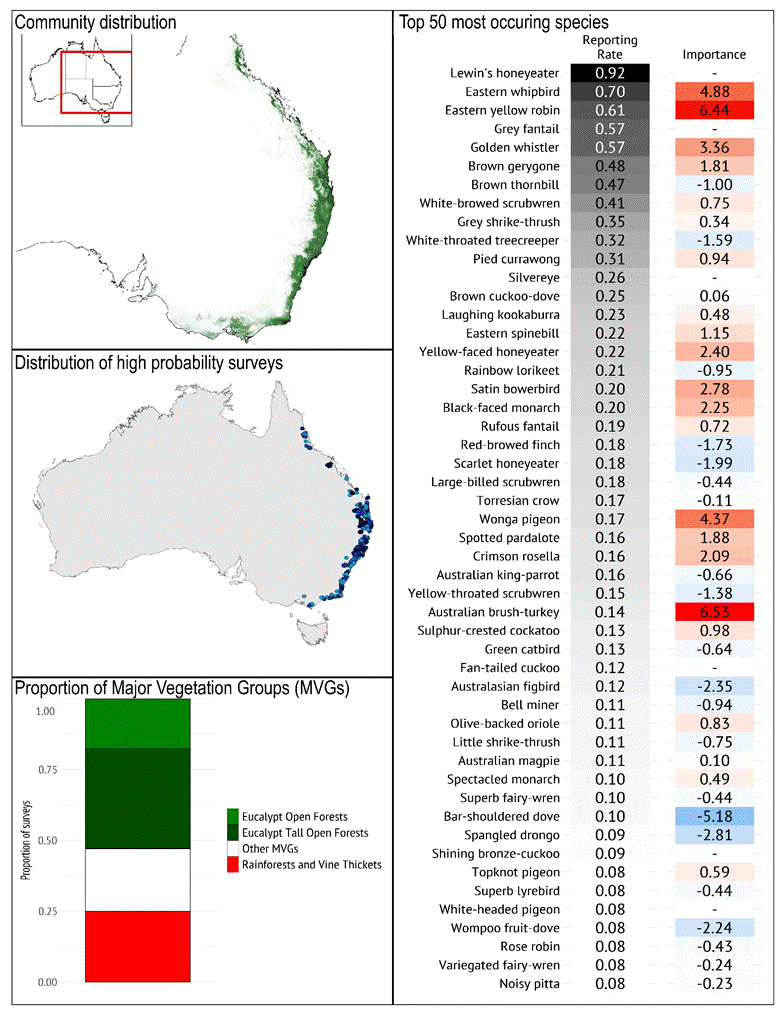
The Eastern Wet Forest bird community typically occurs in the more mesic, taller eucalypt-dominated forests close to the east coast, along the eastern/southern slopes of the Great Dividing Range, typically in cool to warm temperate areas. It occurs on mainland Australia and is distinct from those in similar vegetation in Tasmania.
Species composition
Typical species: It is typified by high prevalence of Lewin’s Honeyeater, Eastern Whipbird, Eastern Yellow Robin, Golden Whistler, White-browed Scrubwren, and Grey Fantail. The species which are more likely to occur in this community than the other communities in this region include Eastern Whipbird, Eastern Yellow Robin, Wonga Pigeon, Satin Bowerbird; it largely lacks the High-elevation Tropical Rainforest endemics (though some typical rainforest species intrude along the ecotone between Eastern Wet Forest and High Elevation Tropical Rainforest communities (Chapman & Kofron 2010) and coastal woodland species such as White-cheeked Honeyeater.
Guild structure: The bird community is dominated by insectivores, small to medium-sized nectarivores and frugivores with a relatively high proportion of ground- and shrub-foraging insectivores (Milledge & Recher 1985; Recher et al. 1985; Chapman & Kofron 2010). Large forest predators including those reliant on tree hollows for nesting occur (e.g. Powerful Owl, Sooty Owl) but are not captured well by standard 2-ha 20-min surveys so aren’t reflected well in the reporting rates and importance scores presented here.
Temporal dynamics: The composition of the Eastern Wet Forest community includes a group of long-distance migratory species (e.g. Rufous Fantail, Olive-backed Oriole, Satin Flycatcher, Yellow-faced Honeyeater) that typically move south in spring and return north in late summer (Kikkawa 1968; Griffioen & Clarke 2002). The seasonal composition of the community is also influenced by local altitudinal migrants such as Brown Gerygone and Black-faced Monarch (Robinson 1993). Together these species are an important seasonal (spring-summer) component of the bird communities (Recher et al. 1983). Moderately high inter-annual variation in climatic conditions and food availability drive interannual dynamism of several honeyeater species (Mac Nally 1995; Mac Nally & Timewell 2005).
Geographical variation: In the far north, species that occur in the ecotone between the High Elevation Tropical Rainforest and Eastern Wet Forest communities appear in this community e.g. Mountain Thornbill, Bridled Honeyeater (Chapman & Kofron 2010).
Vegetation/habitat associations
The Eastern Wet Forest bird community is most prevalent in Eucalypt open forests, Eucalypt tall open forests and rainforest and vine thicket Major Vegetation Groups (MVGs). There was no separate bird community identified for the lowland rainforests which is consistent with the literature (Recher et al. 1991). Common dominant canopy species include Mountain Ash (Eucalyptus regnans) in Victoria’s central Highlands, Flooded Gum Eucalyptus grandis and a mix of sclerophyllous tree species – e.g., Red Stringybark, (Eucalyptus resinifera), Turpentine (Syncarpia glomulifera) and Swamp Box (Lophostemon suaveolens) in wet sclerophyll forests of tropical north-east Queensland. The community can also occur in the drier foothill forests adjacent to wetter areas. A high degree of structural complexity of vegetation typifies this community, and the typical species of this community require dense, low shrub cover (e.g. Eastern Whipbirds and White-browed Scrubwrens), trees with rough or decorticating bark for White-throated Treecreepers, and diverse forest strata for many species, for example Grey Fantail, Lewin’s Honeyeater, Golden Whistler, Brown Thornbill, that glean, sally or probe amongst the subcanopy. Timber harvesting and fire influence the structural and compositional characteristics of this community and succession following these disturbances may result in major variation in bird composition (Serong & Lill 2012).
High Elevation Tropical Rainforest
Geographical occurrence
The High Elevation Tropical Rainforest bird community highly restricted community occurs only in the high elevation rainforest areas of the wet tropics bioregion, far north Queensland.
Species composition
Typical species: The community is typified by the prevalence of Grey-headed Robin, Lewin’s Honeyeater, Spotted Catbird, Chowchilla, Bridled Honeyeater and White-throated Treecreeper. The species whose presence makes it more likely for a bird list to be deemed part of the High Elevation Tropical Rainforest bird community than the other communities in the region include Grey-headed Robin, Chowchilla, Spotted Catbird, Bridled Honeyeater, Victoria’s Riflebird, and Macleay’s Honeyeater. This community includes a large number of range-restricted species that only occur at high elevations and are increasingly threatened by the warming climate (De La Fuente et al. 2023).
Guild structure: This community has a particularly high proportion of frugivores and ground-foraging insectivores.
Temporal dynamics: The composition of this community is relatively stable seasonally, dominated by residents, but it is changing with climate and its boundaries are shifting to higher elevations; lowland species are also becoming more common (Williams & De La Fuente 2021).
Geographical variation: As this community occurs over a very small area primarily above ~800 m elevation there is little geographical variation; elevation is the primary determinant of composition (Williams et al. 2010).
Vegetation/habitat associations
The High Elevation Tropical Rainforest bird community is most prevalent in the rainforest and vine thicket Major Vegetation Group, and occasionally occurs in ecotonal areas with Eucalypt Tall Open Forest (Kutt & Vanderduys 2017).

