Two bird communities that occur only on the island of Tasmania were identified: the Tasmanian Wetter and Tasmanian Drier forest bird communities. These communities often occur in close proximity (Figure S1.1), with their distribution influenced by factors such as elevation, aspect and fire history (Wood et al. 2011; Lunn et al. 2018).
Tasmania’s climate is characterized by cool to mild, wet winters and warm, dry summers, resulting in a gradient of vegetation types that support the two identified bird communities. The wetter forest bird community is generally found in the western and southern regions, coinciding with areas of higher annual rainfall, and vegetation is typically dense and closed-canopied (but not exclusively in area of vegetation consistent with the Specht classification of Wet Forest (Specht 1970). These habitats tend to support a subset of bird species that frequent moist, shaded environments including the Tasmanian Scrubwren and Pink Robin. Conversely, the drier forest communities occur more in northern, eastern and central Tasmania, where open forests and woodlands prevail, and species that prefer lower canopy cover and a more open habitat structure are more common (but not exclusively in area of vegetation consistent with the Specht classification of Dry Forest; [Specht 1970]).
The Tasmanian region and the two represented communities are unique due to the presence of a high number of endemic species, including the Tasmanian Scrubwren and the Yellow-throated Honeyeater, which contribute to the distinctiveness of its avifauna. These high rates of endemism likely reflect significant recent speciation following the end of the last Ice Age when sea levels rose isolating Tasmania from the Australian mainland around 8-12,000 years ago (Rldpath & Moreau 1966). Common and widespread species such as the Grey Shrike-thrush, Superb Fairy-wren, and Grey Fantail can be found in both communities, highlighting their adaptability to a range of habitat conditions across the island.
An additional feature of Tasmanian bird communities is the prevalence of regional migrants, and Bass Strait migrants. Regional migrants, particularly altitudinal migrants, move away from higher elevation areas (e.g. >800 m) to lower altitudes including near-coastal settings in the austral winter (Rldpath & Moreau 1966; Abbott 1972; Brereton & Taylor 2000). For Bass Strait migrants, some or all of the Tasmanian populations of these species migrate to the Australian mainland for variable periods over winter (Abbott 1972). Examples of obligate Bass Strait migrants include Satin Flycatcher, Dusky Woodswallow and Pallid Cuckoo, whilst examples of partial Bass Strait migrants (only some of the population migrates) include Flame Robin, Silvereye and Grey Fantail. Bass Strait migration, particularly the significant over-water crossing of several hundred kilometers, is also a relatively recent phenomenon that will have been influenced by sea-level rise 8-12,000 years ago (Rldpath & Moreau 1966).
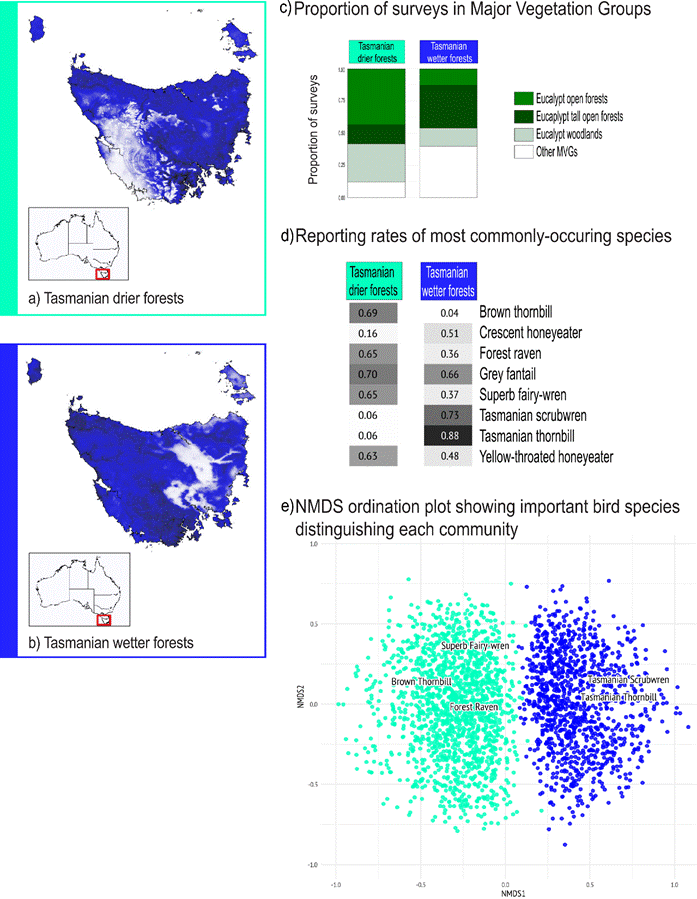
Figure Region A1: Tasmania a) and b): Inset maps show location of region, larger maps show modelled distribution of communities based on Maxent models, with darker shading representing a higher likelihood of occurrence. c) proportion of surveys in each community occurring in Major Vegetation Groups (MVGs; MVGs in which >10% of surveys were located shown). d) reporting rates (RR) of the top 5 most commonly occurring species in each community. e) Non-metric multidimensional scaling (NMDS) ordination plot depicting the location in multidimensional space of key species that distinguish communities in this region.
Tasmanian Drier Forest
Geographical occurrence
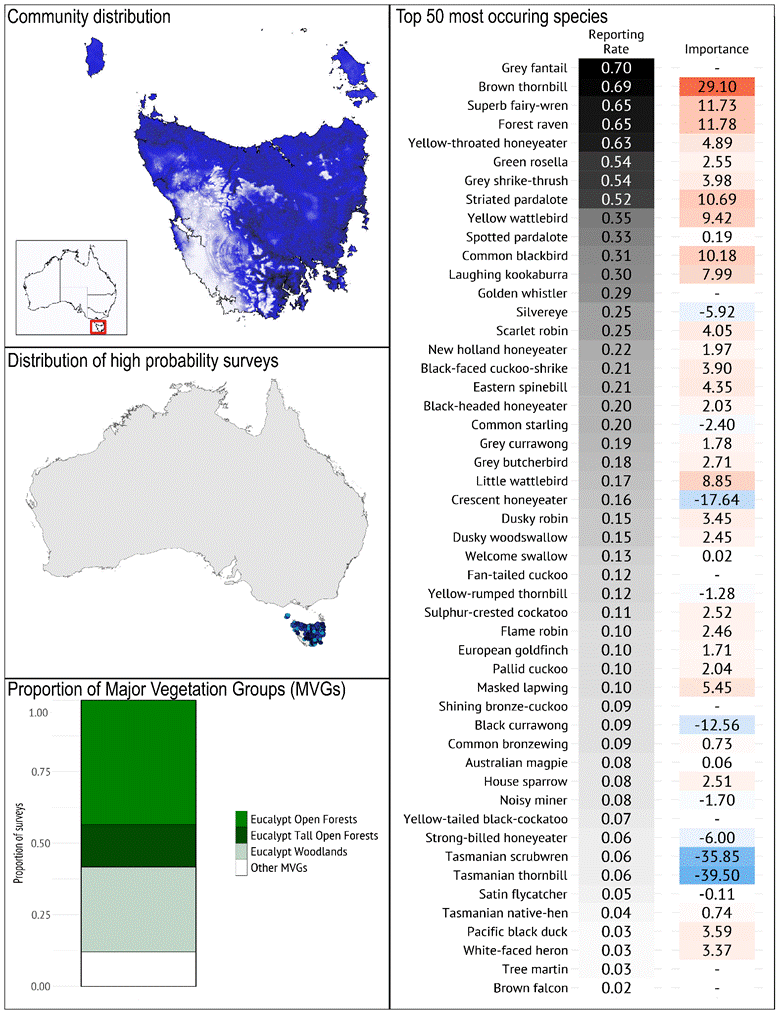
The Tasmanian Drier Forest community occurs in eucalypt forest and woodland across Tasmania and the larger Bass Strait islands, except for the south-west of Tasmania, where the Tasmanian Wetter Forest bird community dominates.
Species composition
Typical species: The Tasmanian Drier Forest bird community contains many species typical of woodlands and open forests across eastern Australia, including brown thornbill, grey fantail, superb fairy-wren and grey shrike-thrush, but also has high prevalence of Yellow-throated Honeyeater, a Tasmanian endemic, and the Forest Raven. The community includes 8 Tasmanian endemic species. It is much less likely than the Tasmanian Wetter Forest bird community to support Tasmanian Thornbill, Tasmanian Scrubwren, and Pink Robin.
Guild structure: This community is dominated by small- to medium-sized insectivores and nectarivores, most of which forage in the canopy and subcanopy, and fewer ground-foragers than the Tasmanian Wetter Forest community.
Temporal dynamics: There is a large group of summer migrants, arriving in spring leaving Tasmania in Autumn to overwinter on the mainland. For example, Grey Fantail, cuckoos, Flame Robin, Satin Flycatcher, Black-faced Cuckoo-shrike, Dusky Woodswallow, Tree Martin, Striated Pardalote, Eastern Spinebill (Abbott 1972; Brereton & Taylor 2000).
Geographical variation: As this community is restricted to Tasmania and Bass Strait, there is limited compositional variation across its range; all typical species are distributed throughout its extent.
Vegetation/habitat associations
The Tasmanian Drier Forest bird community occurs mainly in Eucalypt open forest and Eucalypt woodlands, and although it is recorded in Eucalypt Tall Open Forests, it is less likely to occur there than is the Tasmanian Wet Forest bird community.
Tasmanian Wetter Forest
Geographical occurrence
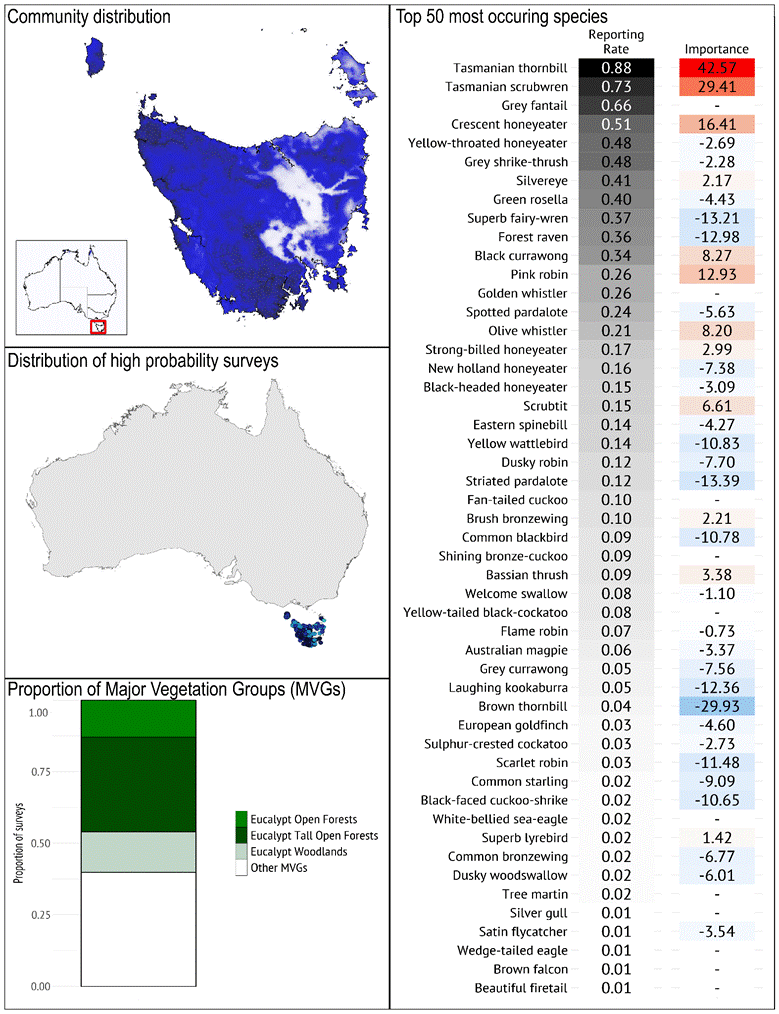
This community occurs in more mesic forests across Tasmania with the exception of some parts of the central inland.
Species composition
Typical species: It is typified by the prevalence of Tasmanian Thornbill, Tasmanian Scrubwren, Grey Fantail, Crescent Honeyeater, and Grey Shrike-thrush. The presence of Tasmanian Thornbill and Tasmanian Scrubwren is a strong indicator of the bird community belonging to the Tasmanian Wetter Forest community rather than to the Tasmanian Drier Forest community.
Guild structure: The community is dominated by small to medium sized insectivores, as well as species that forage on the ground or in dense understory, especially gullies (Tasmanian Scrubwren, Pink Robin, Scrubtit).
Temporal dynamics: Some species in this community show local altitudinal movements presumably to avoid the harshest weather in winter (Ridpath & Moreau 1966). As with drier forests, there is also a large group of summer migrants such as Crescent Honeyeater, Slivereye, Grey Fantail, cuckoos, and Tree Martin (Abbott 1972; Brereton & Taylor 2000).
Geographical variation: Some species, such as Black Currawong, Tasmanian Thornbill, Pink Robin, Olive Whistler and Crescent Honeyeater, are more likely to occur in the cooler higher altitude tall eucalypt and cool temperate rainforests (Thomas 1980).
Vegetation/habitat associations The Tasmanian Wetter Forest bird community is more likely to be found in areas with the Eucalypt tall open forest Major Vegetation Group (MVG) than the Tasmanian Drier Forest bird community.

