PhD and Honours project opportunities
Opportunities exist for prospective PhD and Honours students in conservation policy analysis, in Australia and globally, and woodland bird conservation. Feel free to contact us if your ideas align with our other research areas, too. Note in particular the advice on scholarship eligibility and what information to attach to your enquiry. Information about scholarships for postgraduate research at The University of Queensland is available here. If you are an international applicant for PhD candidature, please take care to familiarise yourself with the scholarships for which you might be eligible, and note they are highly competitive.
***Four funded PhD projects now available in fauna conservation***
The below four PhD opportunities are currently available for domestic applicants (and onshore internationals studying at UQ) to join the vibrant Centre for Biodiversity and Conservation Science at the University of Queensland. Research costs are fully funded but require the applicant to apply for a scholarship in the round closing 24th March 2024, for study commencing in the second half of 2025. Details and eligibility requirements are available here. If you are interested and meet the eligibility requirements, please contact the primary supervisor listed for the project of interest by 8th March, 2024.
- Ecological and conservation impacts of noisy miner control in subtropical woodlands
The noisy miner (Manorina melanocephala) is a native honeyeater which is widespread in eucalypt woodlands across eastern Australia. Land use changes have benefited the noisy miner leading to increases in occupancy and abundance. Their aggressive behaviour and excludes almost all smaller woodland bird species from within their territories which contributes to the decline of woodlands birds, resulting in noisy miner overabundance being listed nationally as a Key Threatening Process under the Environmental Protection and Biodiversity Conservation (EPBC) Act 1999. However, their broader effects on ecosystem health are poorly understood.
This project aims to develop a greater understanding of the effects of noisy miners (Manorina melanocephala) on the health of subtropical woodland ecosystems, and test an experimental approach to reducing negative impacts. The fieldwork will be based in the woodland landscapes around the UQ Hidden Vale Wildlife Centre in south-east Queensland, about 1.5 hours from the St Lucia campus. We are seeking students with experience in Australian bird and/or plant identification and survey methods, and an enthusiasm for field-based work.
Primary supervisor: Prof Martine Maron m.maron@uq.edu.au co-supervisor: Dr April Reside
2. The FaunaHealth Index: Developing fauna community condition metrics for Australia
This PhD project is part of an ARC Linkage-funded research program aiming to develop new indicators of the health of fauna communities. This project aims to improve how biodiversity is measured by developing a system to describe the condition of animal communities, analogous to those used for plant communities. It is currently developing and testing a system for Australia’s terrestrial birds, before extending the approach to wetland and coastal birds, and to mammal and frog communities. Collectively, these metrics will enable holistic and relevant measures of the biodiversity value of sites, improve evaluation of restoration actions, reveal trends in community condition, and inform monitoring and evaluation tools for emerging biodiversity markets.
The specific focus of the PhD is flexible, and prospective students with an interest in community ecology and conservation of any vertebrate fauna group are welcome to apply. We are seeking students with skills in managing large databases and spatial data analysis, and who enjoy working with diverse stakeholders and in collaborative research teams.
Primary supervisor: Prof Martine Maron m.maron@uq.edu.au
The following projects are based in Dr April Reside’s lab:
3. Evaluating the impact of major threats to Endangered reptiles in an intensive agricultural landscape
Half of the Australian reptiles most at risk of extinction occur in Queensland; and five are grassland earless dragons. Critical knowledge gaps forestalling recovery of threatened reptiles include the impact and mitigation of key threats: habitat loss and degradation, and invasive species; and how these threats interact. The southern Brigalow Belt of Queensland is home to threatened reptile species such as Condamine earless dragon (Tympanocryptis condaminensis), Roma earless dragon (T. wilsoni), Grey snake (Hemiaspis damelii) and Five-clawed Worm-skink (Anomalopus mackayi). Like many species of grassland and floodplain ecosystems, the habitat of these reptile species has been subject to degradation, fragmentation and loss resulting from agricultural intensification, road upgrades and maintenance, and weed and pasture species that change soil structure and functioning. Land management that creates and maintains habitat for these species is crucial to their persistence.
This project will investigate the impact of the major threatening processes by surveying the species via traditional and innovative survey methods, and measure habitat features at multiple scales to capture the species’ associations with different land use and management. It will also assess the threat posed by introduced predators (cats and red foxes) on the Endangered reptiles, and identify the key recovery actions required.
Primary supervisor: Dr April Reside a.reside@uq.edu.au; More info: https://www.wildlifeconservationlab.com/condamine-earless-dragon
4. Social and ecological determinants of persistence of threatened reptiles in an intensive agricultural landscape
Land management practices play a critical role in the suitability of habitat for species across over half of the Australian continent that is under agricultural production. Yet details of practices that support the threatened species specialised to each region are largely unknown, particularly across the vast landscapes of Queensland. Furthermore, the social and ecological factors that influence landholders’ decisions to adopt reptile-friendly management practices is insufficiently understood. Identifying key enablers or constraints of reptile-friendly land management will inform strategies to promote greater adoption across the species’ range.
This project will work with the landholders that are the custodians of threatened reptile species, focussing on the Endangered, narrow-ranged Condamine earless dragon (Tympanocryptis condaminensis), to understand the land management histories associated with reptile presence, landholders’ perceptions of reptile-friendly land management practices, and factors influencing the willingness to adopt these practices. Applicants to this project will require a strong background in social science.
Primary supervisor: Dr April Reside a.reside@uq.edu.au co-supervisor: Dr Angela Dean a.dean@uq.edu.au; more info: https://www.wildlifeconservationlab.com/condamine-earless-dragon
General research areas: if you have specific interests in the following areas, please feel free to get in touch
Managing threats to Australia’s bird communities
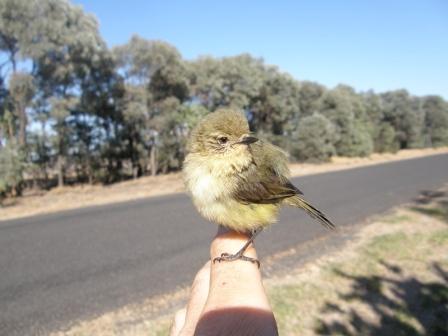
80% of eastern Australia’s temperate woodlands are gone, and the classically Australian woodland bird community that is bound inseparably with them is disintegrating. Over 40 species are threatened with extinction at State and/or Commonwealth levels, including species such as the regent honeyeater and speckled warbler. Restoring Australia’s woodlands is crucial not only for the many threatened bird species that rely on them, but for the long-term functioning of the woodlands themselves. With such a large number of co-occurring bird species under threat, and more likely to be listed if threats are not abated, developing integrated approaches that most cost-effectively deliver on-ground management is key. We have projects available evaluating, and developing solutions to, key threats, such as landscape transformation from clearing and weed invasion, and increasing interspecific competition with native Noisy Miners, which is now listed as a Key Threatening Process.
There are opportunities for postgraduate research projects on: 1) exploring impacts of yellow-throated miners and invasive buffel grass on woodland birds in Queensland; 2) comparing woodland bird survey snapshots from across a 25-year period to infer local extirpations of species, and examining how interannual variation affects our ability to detect trends; 3) developing a suite of woodland bird community metrics to track community condition across Australia (see above project) and 4) evaluating declines in grey-crowned babblers in south-east Queensland. Prospective Honours or PhD candidates interested in projects in this area should contact Martine Maron m.maron@uq.edu.au and send a CV and transcript of undergraduate results. Applicants for PhD candidature will need to apply for and obtain an Australian Postgraduate Award or equivalent scholarship (information available at http://www.uq.edu.au/grad-school/scholarships-and-fees).
Translating global net gain goals to real landscapes: improving impact mitigation and ecological compensation to align with global targets
In 2022, the nations of the world agreed on a new global framework for biodiversity conservation. It includes goals of net gain in ecosystem extent and integrity, and in abundance of wildlife populations. However, at the same time, development imperatives continue to cause biodiversity losses. Minimising such pressure is key – but ‘net’ gain implies some impacts will still occur, but be counterbalanced with gains. How feasible is this? Some mechanisms exist – for example, biodiversity offsetting involves attempting to compensate for environmental damage at one location by generating ecologically equivalent gains at another location. Usually the stated goal is ‘no net loss’ of biodiversity. This policy approach is increasingly being used in an attempt to reduce conflict between development (e.g. for mining and urbanisation) and conservation. However, despite rapid worldwide growth in offsetting, biodiversity offset decisions are often ad-hoc, nonstrategic, and made within a policy framework whose long-term implications are poorly understood.
The program of research aims to better understand how to align global net gain goals with the reality of development pressures on the ground, and develop approaches that reduce the risk of poor outcomes for biodiversity from offset trading. Prospective PhD candidates interested in projects in this area should contact Martine Maron m.maron@uq.edu.au and send a CV and transcript of undergraduate results. Applicants for PhD candidature will need to apply for and obtain an Australian Postgraduate Award or equivalent scholarship (information available at http://www.uq.edu.au/grad-school/scholarships-and-fees).
 Maron Ecology & Conservation Policy Lab